
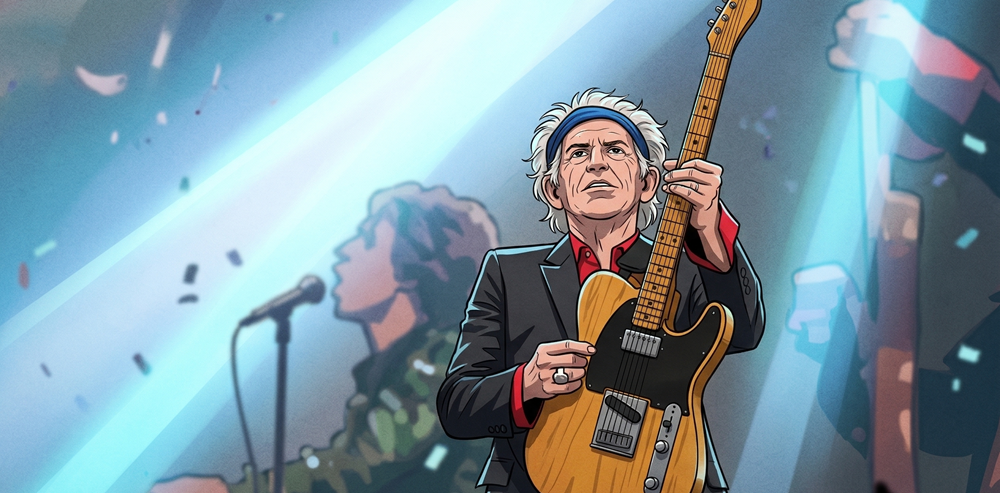
Keith Richards is proof that the most powerful tones are built from restraint. His signature sound sits right at the edge of breakup — never fully distorted, never fully clean — with a bright, mid-forward character driven by his iconic five-string open G tuning on a Telecaster. The key is low gain, high treble, and just enough volume to let the amp breathe.
Tone Snapshot
| Characteristic | Description |
|---|---|
| Overall Character | Bright, slightly gritty, jangly — sits on the edge of breakup |
| Gain Level | Very low — natural amp overdrive at moderate volume |
| Low End | Controlled and light — five-string open G removes the low bass mass |
| Mids | Present and punchy — forward enough to cut through a full band mix |
| Highs | Bright and open — treble is always pushed up |
| Best For | Classic rock rhythm, rolling chord riffs, open-tuning drone patterns |
Keith Richards Gear Reference
Guitars
- 1953 Fender Telecaster "Micawber" — His most iconic guitar, five-string open G tuning (G-D-G-B-D), neck pickup replaced with a Gibson PAF humbucker in the mid-70s for added warmth
- 1954 Fender Telecaster "Malcolm" — Second five-string open G Tele, also fitted with a Gibson PAF neck pickup
- Gibson ES-355 — Used on several recording sessions for a fuller, semi-hollow tone
- Custom Shop Fender Telecasters — Modern touring backups built to mirror the open G five-string setup
Amplifiers
- 1958–59 Fender Tweed Twin (5F8-A) — Primary live amp for decades; runs two Tweed Twins on stage plus two more on a B-stage. Punchy, mid-forward, naturally breaks up at moderate volumes
- Fender Twin Reverb Silverface — Used on tour and in various studio contexts; cleaner headroom than the Tweed
- 1957 Fender Champ — Key studio workhorse; plugged into Input 2, turned up to about 4 for just-breaking-up tones. Low wattage, big character
- 1956 Fender Harvard — Additional studio amp; small and punchy with natural breakup characteristics
- Ampeg VT-22 — Used in the early 70s as a louder alternative to the Fender Twin
Key Pedals
- Maestro Fuzz-Tone — The original fuzz pedal; defines the riff on "Satisfaction" — one of the most famous fuzz tones in rock history
- Ibanez TS9 Tube Screamer — Used for added edge without going fully distorted; keeps the amp-centric feel intact
- MXR Phase 100 — Heard on "Shattered" and various 70s era tracks; adds movement without obscuring the rhythm
Recommended Amp Settings
These settings target the Fender Twin Reverb Silverface (Vibrato channel) — the most accessible version of Keith's live tone. The Tweed Twin settings are very similar; dial back volume to about 3–4 for natural breakup. Keith always uses Input 2 on his studio Champ and keeps it around 4.
| Control | Setting | What It Does Here |
|---|---|---|
| Volume | 4 | Low enough for control but high enough to encourage the amp to naturally break up on hard strumming — the sweet spot for Keef's edge-of-overdrive feel |
| Treble | 7 | Pushed up to give that bright, open Telecaster snap — his open G tuning naturally removes low-end mass, so treble can run high without getting thin |
| Middle | 5 | Kept at noon to maintain body and presence in the mix — don't scoop it, you'll lose the punch that makes his rhythm playing cut through |
| Bass | 4 | Kept light intentionally — his five-string setup already removes the low E, so extra bass just muddies the drone sound |
| Reverb | 3 | Just a light touch — enough to give the notes some air and room, but not enough to obscure the rhythm attack |
| Bright Switch | ON | Engage the bright switch on the Vibrato channel — it adds presence and sheen that's key to the Tweed-era brightness Keith chases |
EQ Profile
Bright, treble-forward shape — light bass, scooped slightly below the midrange center, with highs running open and airy
Getting the Tone Without the Exact Gear
You don't need a 1958 Tweed Twin. The soul of Keith's tone is low-gain, treble-bright, naturally breaking up — and plenty of amps can get you there:
| Budget Level | Amp Option | Why It Works |
|---|---|---|
| Budget (~$200–400) | Fender Champion II 100 or Fender Frontman 212R | Built-in tweed-inspired voicing; turn the gain low and treble up — good entry point for the bright, cutting character |
| Mid-range (~$500–900) | Fender Blues Junior IV or Fender Blues Deluxe Reissue | The Blues Junior's Fat switch thickens the mid-range without adding gain; the Deluxe Reissue's single-channel simplicity mirrors the Tweed Twin approach perfectly |
| Premium (~$1000+) | Fender '65 Twin Reverb Reissue or Fender Tweed Blues DeVille | The Twin Reverb Reissue is the most faithful modern equivalent to Keith's live rig — same headroom, same bright character, same controls |
Quick Tone Fixes
| If Your Tone Sounds… | Try This |
|---|---|
| Too muddy / bassy | Drop bass to 3, check that you're not using the Normal channel (use Vibrato channel on the Twin Reverb), and make sure the bright switch is engaged |
| Too harsh / shrill | Pull treble back to 6 and boost middle slightly to 6 — adds warmth without losing the jangle. Also check your guitar's tone knob; Keef runs his at full |
| Too clean / sterile | Push the volume knob slightly higher to get the amp moving. Keith's sound is about amp response, not pedal gain — let the volume do the work |
| Not enough bite | Use a Tube Screamer at low gain (drive at 2–3, tone at 6) as a clean boost — it tightens and brightens without overwhelming the amp's own character |
Common Mistakes to Avoid
- Playing in standard tuning Keith's tone is inseparable from his five-string open G tuning. The absence of the low E string and the open chord voicings fundamentally shape the sound — playing in standard tuning on a six-string won't get you there, even with perfect amp settings.
- Adding too much gain Keith almost never uses high-gain distortion. The Maestro Fuzz-Tone on "Satisfaction" is the outlier, not the rule. Most of his catalog is light amp breakup or clean tone — cranking a gain knob will push you further from his sound, not closer.
- Boosting bass to compensate for thinness If the tone sounds thin, the instinct is to add bass — but that's the wrong fix here. Keith's tone is intentionally light in the low end. If it's thin, boost middle and presence instead, or push the amp's volume higher for natural warmth.
- Ignoring the guitar's role A Telecaster (or a bright single-coil guitar) is central to this sound. Using a humbucker-heavy guitar will require significant EQ compensation — push treble higher and mid lower to approximate the single-coil snap, but accept that the fundamental character will differ.
Keith Richards' tone is about voltage, not gain — it lives in the space between clean and broken up, driven by volume and attack rather than pedals or distortion channels. Get a bright Fender-style amp, push the volume until it starts to breathe, lean on the treble, lighten the bass, and let your right hand control the dynamics. The five-string open G tuning is the secret ingredient no amp setting can replicate on its own.
More Amp Settings Content
Written by Bobby Kittleberger on Artists & Amp Settings
Written by Bobby Kittleberger on Artists & Amp Settings

Comment Policy: You're down to leave a comment? That's awesome. Keep in mind that comments are moderated and rel="nofollow" is in use. Please avoid any spammy keywords or a domain as your name, otherwise your comment will be deleted. Let's stay on topic, keep questions relevant and have a meaningful conversation. All the best.