
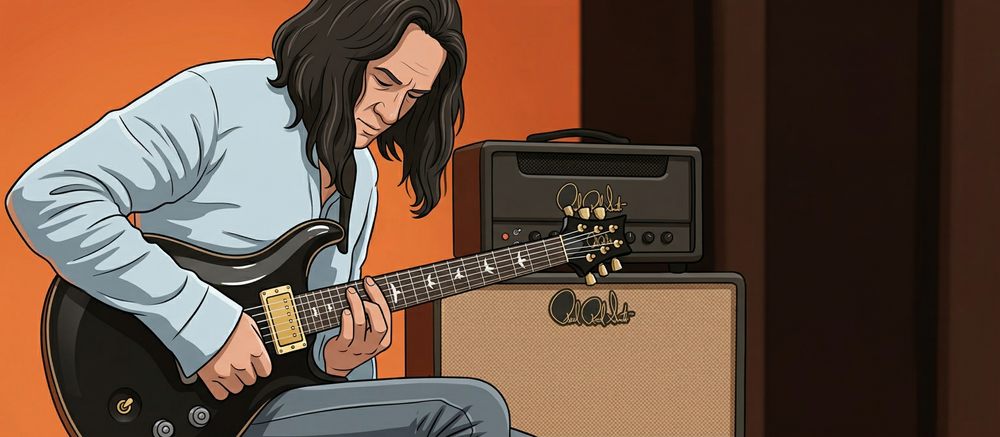
Robben Ford is one of the most revered blues-jazz guitarists alive, known for a tone that sits perfectly between warm and articulate — never strident, always singing. His signature sound is built on flat or near-flat EQ settings, letting a Dumble Overdrive Special (or a Fender Super Reverb with a Zendrive pedal) handle the character, while his picking dynamics and phrasing do the emotional heavy lifting. The result is a tone with full, controlled lows, punchy mids, and crystal-clear highs that works equally well for clean jazz chords and soaring, slightly overdriven single-note lines.
Tone Snapshot
| Characteristic | Description |
|---|---|
| Overall Character | Warm, smooth, and articulate — blues feeling with jazz harmonic refinement |
| Gain Level | Low to medium — clean to mildly overdriven; dynamics driven by touch |
| Low End | Full but not woofy — controlled and musical even at volume |
| Mids | Punchy and present — the core of the Dumble character; sings through any mix |
| Highs | Clear and airy — never harsh or ear-piercing, highly musical |
| Best For | Blues, jazz-fusion, smooth R&B, expressive lead playing, clean chord work |
Robben Ford Gear Reference
Guitars
- Gibson ES-335 (1959 Sunburst Dot Neck) — his primary guitar through the Yellowjackets era; the semi-hollow contributes warmth and natural compression to the tone
- Fender Telecaster — used for brighter, twangier blues material; adds snap and cut without losing the smooth character
- Gibson Les Paul — occasionally used for thicker, more sustained tones on heavier blues material
- PRS Robben Ford Signature — a custom collaboration offering a hybrid of the ES-335 and Les Paul feel
Amplifiers
- Dumble Overdrive Special #002 — his primary amp since 1983; the amp that defined his modern tone; built specifically for him by Alexander Dumble
- Fender Super Reverb — his touring fallback and preferred amp when the Dumble can't travel; run with flat EQ and a Zendrive pedal to approximate the Dumble character
- Fender Twin Reverb — secondary Fender option; used similarly to the Super Reverb with flat settings and pedal-driven overdrive
Key Pedals
- Hermida Audio Zendrive — the single most important pedal in his rig; designed specifically to replicate the Dumble Overdrive Special character on a Fender amp
- Strymon TimeLine — his primary delay; set around 116ms for a natural, non-intrusive slapback-style echo
- TC Electronic Hall of Fame Reverb — subtle room reverb to add space without wash
- Vertex Boost — used for lead volume push rather than gain coloring
- TC Electronic PolyTune Mini — tuner pedal
Recommended Amp Settings
Ford's approach is intentionally flat — he lets the amp's natural voicing and his playing dynamics do the work. These settings are based on his known preference for flat EQ on Fender amps (all controls near 5) with the Zendrive providing breakup character when needed.
| Control | Setting | What It Does Here |
|---|---|---|
| Volume | 6 | Enough stage volume to push the amp into its natural sweet spot; Dumble character blooms when the output transformer is working |
| Treble | 5 | Flat/unity — Ford explicitly favors flat EQ on Fenders; the amp's natural voice handles the top-end shaping |
| Middle | 5 | Flat — Dumble-style voicing thrives on punchy, uncut mids; keep unity to preserve the singing quality |
| Bass | 5 | Flat — controlled low end that doesn't mask clarity; reduce to 4 if your guitar or room gets boomy |
| Reverb | 3 | Light and natural — just enough to place notes in a room without washing out single-note articulation |
| Zendrive Gain (OD pedal) | 4 | Mild breakup that responds to pick attack — dig in for grit, back off for clean; this is the Dumble character approximation on a Fender amp |
| Zendrive Voice | Noon | 12 o'clock on the Voice knob delivers the most balanced, Dumble-like character |
| Delay (TimeLine) | 116ms | Subtle single-repeat slapback at low mix — creates depth without cluttering melodic phrasing |
EQ Profile
Broadly flat with a slight mid push — the Dumble character zone. Mids carry the singing tone quality.
Getting the Tone Without the Exact Gear
Robben Ford's Dumble Overdrive Special is essentially unobtainable. Here's how to approach his tone at every budget level:
| Budget Level | Amp + Pedal Option | Why It Works |
|---|---|---|
| Budget (~$300–600) | Fender Blues Junior IV + Hermida Zendrive (or clone) | The Blues Jr's voiced midrange responds well to the Zendrive the same way a Super Reverb does — set amp flat, let the pedal shape the OD character |
| Mid-range (~$700–1,200) | Fender Super Reverb (reissue or vintage) + Hermida Zendrive | Ford's actual touring rig when the Dumble can't travel — flat EQ on the amp, Zendrive at low gain for that Dumble-adjacent smoothness |
| Premium (~$2,000+) | Two-Rock Custom Reverb or Carr Skylark + Zendrive | Boutique American voiced amps with Dumble-school DNA — punchy mids, clean headroom, and natural overdrive character closest to Ford's reference tone |
Quick Tone Fixes
| If Your Tone Sounds… | Try This |
|---|---|
| Too muddy / bassy | Pull the Bass back to 4, reduce the low gain on your overdrive pedal — Ford's tone is controlled, not heavy; also back off the guitar's volume slightly |
| Too harsh / brittle | Pull Treble to 4 and lower the Zendrive Voice control below noon — you may also need a darker speaker (Celestion G12-65 or Weber Thames) |
| Too sterile / no character | The Zendrive (or quality Dumble-style overdrive) is essential — without it a Fender amp alone won't deliver the midrange singing quality; make sure drive is engaged |
| Doesn't feel responsive to touch | Reduce your overdrive pedal's gain and play harder — Ford's tone lives in the dynamic range; most of his character comes from digging in vs. barely touching the strings |
Common Mistakes to Avoid
- Cranking the gain too high. Ford's tone is built on restraint. His overdrive comes from the amp's natural character at volume and a lightly-set pedal — not from a high-gain channel. If it sounds like classic rock distortion, you've gone too far.
- Scooping the mids. The V-shape EQ (bass and treble up, mids cut) is the opposite of the Dumble character Ford uses. His midrange punch is the entire identity of the tone — keep mids at noon or slightly above.
- Ignoring playing dynamics. Ford plays with his fingers and thumb much of the time, using touch pressure to control breakup. Even with the right settings, a stiff or uniform pick attack will flatten the tone — practice varying your picking force.
- Too much reverb or delay. Ford uses both sparingly. His delay is set at ~116ms at a low mix — barely perceptible but adds depth. Heavy reverb smears his single-note articulation, which is central to his musical identity.
Robben Ford's tone is not about the amp settings — it's about playing flat EQ into a great amp and letting your hands control the character. Set everything to 5 on a Fender, add a Zendrive pedal at low gain, put in ~116ms of single-repeat delay, and then focus on varying your pick pressure to find where the amp breathes. The tone lives in the dynamic range between barely-touching the strings and digging in hard.
More Amp Settings Content
Written by Bobby Kittleberger on Artists & Amp Settings
Written by Bobby Kittleberger on Artists & Amp Settings

Comment Policy: You're down to leave a comment? That's awesome. Keep in mind that comments are moderated and rel="nofollow" is in use. Please avoid any spammy keywords or a domain as your name, otherwise your comment will be deleted. Let's stay on topic, keep questions relevant and have a meaningful conversation. All the best.