
Guitar Chalk · Amp Settings Resource
Everlong (Foo Fighters) — Amp Settings & Tone Guide
Settings are starting points. Adjust based on your guitar, pickups, and amp. Drop D tuning is required for accurate note reproduction — the open D power chord in the main riff won't translate in standard tuning.
Leave a comment or question below

Quick Reference
Amp Mesa/Boogie Dual Rectifier — Modern channel
Guitar Les Paul-style with dual humbuckers
Tuning Drop D — detune low E string to D
Pickup Position Bridge humbucker for main riff and rhythm
Clean Intro Neck pickup + chorus for the arpeggiated intro
Palm Muting Essential for the verse rhythm — tight, consistent attack
Amp Settings
Everlong — Mesa/Boogie Dual Rectifier (Modern Channel)
High gain with a slightly scooped mid — tight on the low end, present on the top. The Modern channel on the Dual Rectifier handles the saturated crunch without getting muddy. Keep bass controlled; it's easy to make this song sound boomy if you push the low end too hard.
Channel
Modern
Gain
7
Bass
5
Mid
4
Treble
6
Presence
6
Master
5
Output Level
To taste
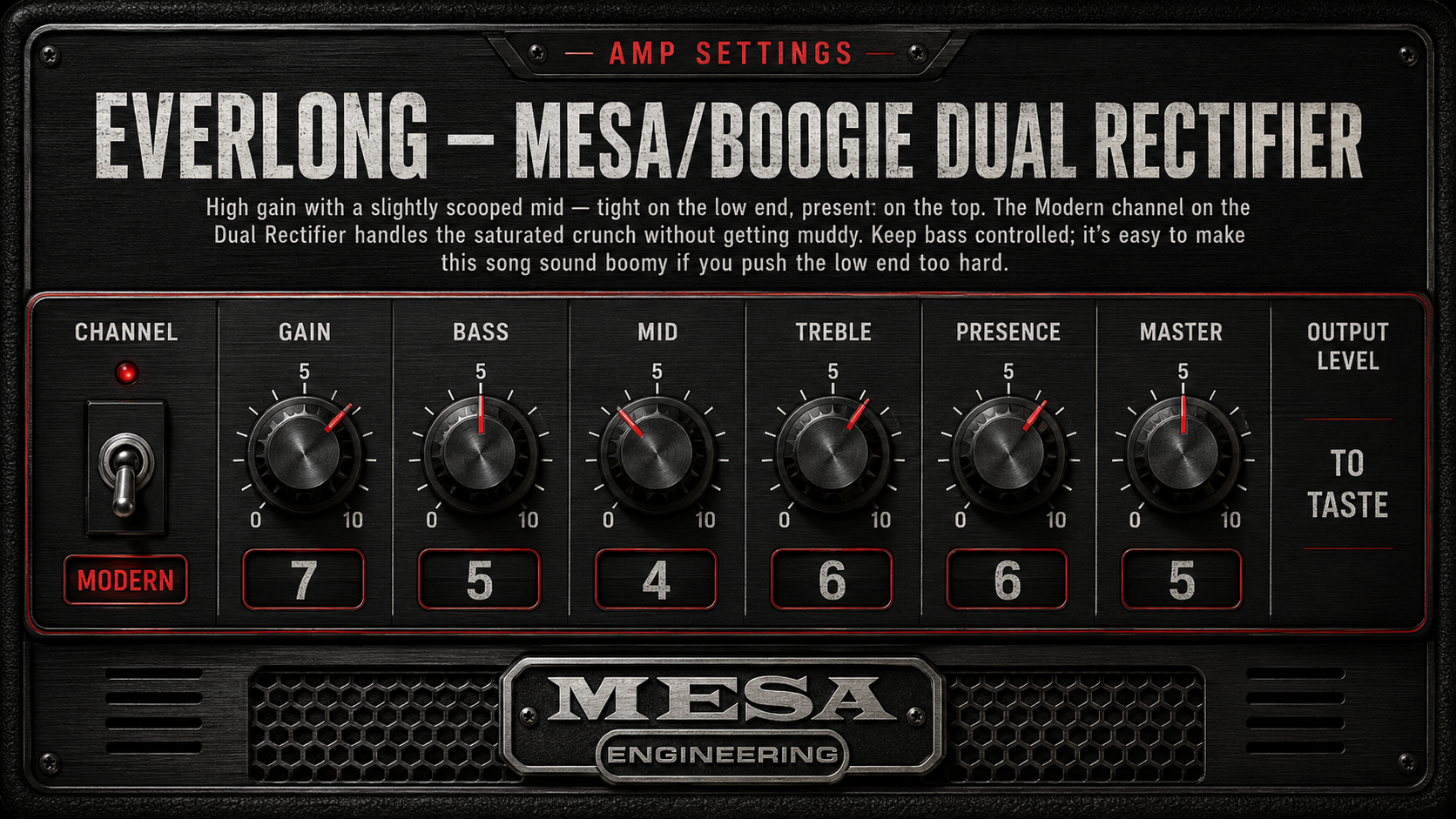
Starting point for a Mesa/Boogie Rectifier amp model. Can work with other amps using a similar control scheme.
Guitar-Related Tone Tips
1. Volume
Set guitar volume near maximum to push the amp and achieve a fuller, more saturated tone. Roll back slightly with the guitar's volume knob during quieter parts. Consistent output is key — the contrast between the palm-muted verse and open-chord chorus relies on picking intensity, not the volume knob.
2. Tone Knob
Keep the tone knob in the 7–9 range for a balanced yet aggressive sound. You want articulation without harshness — the Rectifier's natural voice has enough top end, so don't push the guitar's tone control all the way open unless your pickups are darker-voiced.
3. Pickup Selector
Bridge pickup for the main riff, rhythm parts, and chorus. Neck pickup for the clean intro arpeggio — its warmer voice pairs well with the chorus effect. Middle position is a distant third option; bridge is where the Everlong tone lives for 90% of the song.
4. Humbucker vs. Single Coil
Humbuckers are strongly preferred — tight low end, smooth distortion response, and no 60-cycle hum at high gain levels. Single coils are typically too thin and noisy for the thick, layered distortion of Everlong. Passive humbuckers work well; active pickups aren't required.
5. Ideal Guitar
Les Paul-style guitars with dual humbuckers are the natural fit. Set-neck construction adds sustain for ringing open chords and harmonics. Mahogany body with a maple top gives you the warmth and midrange presence that sits well under heavy gain without turning into noise.
6. Drop D Tuning
Detune your low E string down one whole step to D. This is non-negotiable for the main riff — the open D power chord and low-string passages simply don't work in standard tuning. Tune with a chromatic tuner before playing; Drop D shifts the low string's feel noticeably under palm muting.
Tone Tips and Best Practices
01
Set gain to 6–7 for a saturated but articulate crunch. Too much gain washes out the pick attack and makes palm muting muddy. The Rectifier's Modern channel gets thick fast — dial back if you lose clarity.
02
Keep bass tight — around 4–5 on the dial. In Drop D the low string already pushes a lot of low-frequency energy. Too much bass turns the verse riff into a wall of mud rather than a punchy rhythm part.
03
Add a touch of chorus for the clean intro. This is the most distinctive element of the intro's arpeggiated tone — a subtle, slow chorus (rate around 3, depth around 4) adds the shimmer without sounding like a 1980s ballad.
04
Palm mute consistently and with uniform pick attack. The verse rhythm is almost entirely palm muted — sloppy muting makes the riff sound amorphous. Keep the heel of your picking hand anchored firmly on the bridge saddles.
05
Double-track rhythm parts if recording. The studio version uses doubled rhythm guitars panned left and right. A single rhythm track will sound thinner than you expect — even a rough double-track pass adds significant width.
06
Use a short-feedback delay at low mix for subtle thickening on the lead/chorus sections if needed. This is optional — the core tone doesn't require it — but it helps fill space if you're playing the song solo without a second guitar.
Gear Recommended for Covering Everlong
Mesa/Boogie Dual Rectifier
The amp used on the original recording. The Modern channel's high-gain crunch and tight low end are the closest match to the studio tone — the Vintage channel works but sits warmer and less aggressive.
Marshall JCM800
A reliable alternative if you don't have a Rectifier. Tight distortion, chunky rhythm tone, and a more aggressive upper mid that cuts through a mix. Pair with a boost pedal to push the gain where it needs to be.
Gibson Les Paul (or ES-335)
The Les Paul is the go-to for the main tone — set-neck mahogany body, humbuckers, and a fixed bridge. The ES-335 semi-hollow was used on some studio work by Grohl and adds a slightly more open, resonant quality to clean parts.
Boss DS-1 Distortion
Simple, effective, and the right character for the gritty Foo Fighters rhythm tone. Useful as a boost or standalone distortion source in front of a cleaner amp. Keep tone around 6–7 to avoid getting harsh.
Pro Co RAT
Raw, aggressive distortion with more harmonic complexity than the DS-1 — better suited for the heavier chord sections where you want some grind under the gain. Works well in front of the Rectifier as a pre-gain boost.
MXR M234 Analog Chorus
Subtle modulation for the intro's clean arpeggio tone. Keep rate slow and depth moderate — you want the sound to shimmer, not wobble. Dial back significantly from any default preset; a little goes a long way here.
Ernie Ball Regular Slinky (10–46)
Balanced tension across the fretboard — the 10s give enough resistance for aggressive picking and palm muting without floppiness in Drop D on the low string.
Dunlop Tortex Picks (0.88mm)
Good grip and a firm attack for alternate picking and the palm-muted verse riff. The medium-heavy gauge keeps pick noise consistent without getting clicky at higher tempos.
More Amp and Tone Settings Resources
Written by Bobby Kittleberger on Amp Settings
Written by Bobby Kittleberger on Artists & Amp Settings
We link to products on Sweetwater and REverb that help support our site and keep the lights on. If you click through our orange buttons, we might earn a commission at no extra cost to you. Thank you all for your generous support over the years! ~ Bobby and Danielle
Our disclosure↬


Comment Policy: You're down to leave a comment? That's awesome. Keep in mind that comments are moderated and rel="nofollow" is in use. Please avoid any spammy keywords or a domain as your name, otherwise your comment will be deleted. Let's stay on topic, keep questions relevant and have a meaningful conversation. All the best.