
Best Phaser Pedal (highest Value Option)
Boss PH-3 Phaser Shifter
Even without an analog circuit, the PH-3 boasts a fantastic sound with lots of control, including stage selection. The rest of the modulation EQ is made up of rate, depth, and resonance. We'd like a mix (wet/dry) knob, but as-is, the PH-3 can produce plenty of vintage and modern tones alike.

Image via Gregor Fris
Phaser pedals are a lot of fun and a great way to decorate a clean electric guitar tone. But, if you’re new to phaser pedals, there are a lot of options spanning a wide range of pricing.
Spanning anything from $20 to $200 or even higher, phaser pedals span a broad price range, with several important features to consider. To understand how these variables might impact your decision to buy a phaser pedal, we’ll look at how pricing impacts value and how these features play out in some of the market's best phaser pedals. Let’s start with our top recommendations:
Best Phaser Pedals (top 4 picks)
Phaser | Audio | Rated | SHOP |
|---|---|---|---|
 | Boss PH-3 | 90.3 | |
 | Walrus Audio Lillian | 92.3 | |
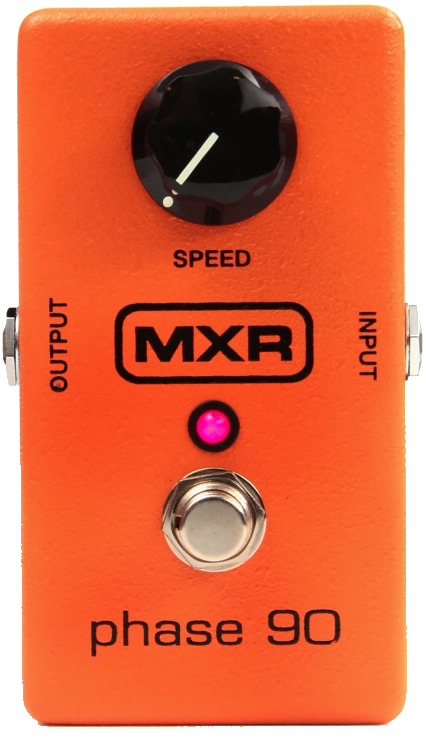 | MXR Phase 90 | 93.0 | |
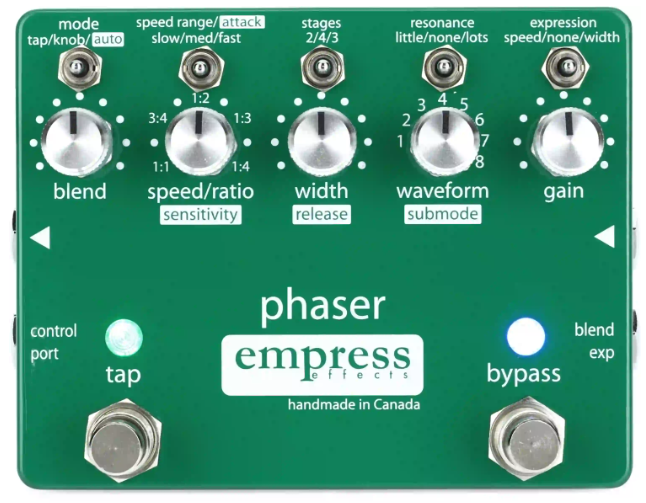 | Empress Phaser | 92.8 |

Out with the old and in with the new. But both are good.
1. Boss PH-3 Phase Shifter Pedal


The Boss PH-3 phaser's versatility makes it applicable to most musical styles, ideal for garage bands and professional guitarists alike. The digital tone doesn't sound overly computerized and is perfect for adding a shimmering modulation layer to a guitar track in the studio. The additional control makes it a better companion for session guitarists than say, the MXR Phase 90, and a good choice for those who enjoy pedal tinkering. It also supports an expression pedal.
BEST FOR: All modulation, clean tones, and recording.
TONE
88
EQ
90
VERSATILITY
95
COST/VALUE
88
- Expression pedal support
- Tempo control
- Multiple stage simulation
- Lots of control
- Boss five-year warranty
- No true bypass
2. Walrus Audio Lillian Phaser Pedal
The Walrus Audio Lillian is an analog phaser pedal with two stages, a three-band EQ, and a Dry-Phase-Vibrato control knob that incorporates a lot of rhythmic elements to the phase cycle. That knob also allows you to morph between the two effects and the dry signal.
It's almost delay-esque in the way it responds to your playing, so I'd recommend it for rhythm players or those who like combining effects. The analog tone is extremely warm and great for layering a clean signal. I'm also a big fan of the Walrus Audio artwork on their pedal casings. They all look great and the Lillian pilot design is no exception.
BEST FOR: Fans of analog circuits and warm modulation.
TONE
95
EQ
92
VERSATILITY
92
COST/VALUE
87
- Three-band modulation control
- D-P-V knob controls dry, phase, and vibrato
- Selectable 4 and 6 stage phasing
- Analog circuits
- Versatile without a ton of dials
- None
3. MXR Phase 90 Analog Phaser
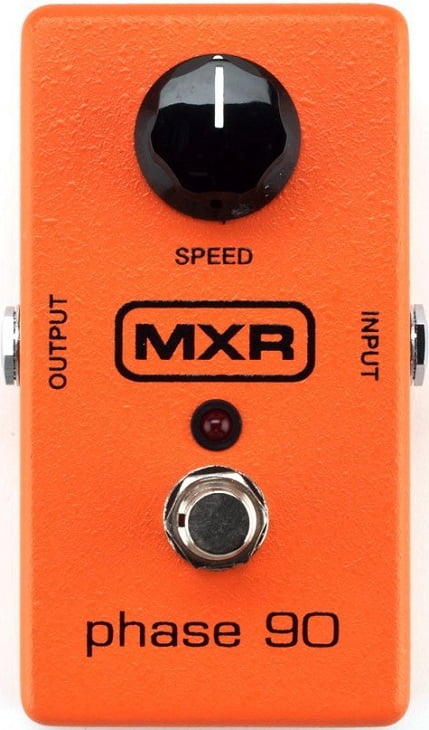
Your experience with the Phase 90 will be a simple one. You'll take it out of the box, plug it in and set a speed. If the analog tone is your thing, it'll make ya happy. Otherwise, there isn't much you can do about altering the tone. This pedal is perfect for those who want an out-of-the-box and ready solution that doesn't need fussed over and can be boiled down to an on or off play-call.
BEST FOR: Classic rock, simple setup, modern rock, basic modulation and analog fans.
TONE
98
EQ
85
VERSATILITY
94
COST/VALUE
95
- Analog tone is excellent
- Simple setup with speed knob can be a plus
- Popular unit with the pros
- Great price point
- Lacks control
- No true bypass
4. Empress Phaser
The Empress Phaser is expensive, but it's one of the single most comprehensive and versatile phaser pedals that I've ever tested. It lets you select stages, waveforms, and then the timing ratio.
This gives you a ton of flexibility compared to most phaser pedals, which either provide a few pre-designed selectable modes or only a single stage setting. Additional controls include speed, attack, gain, and a blend/mix knob. It's also one of the few phaser pedals out there with a tap tempo. If you have the budget, this is absolutely one of my favorite options.
Read the full review: Empress Phaser
BEST FOR: Clean tones, recording, modulation fanatics, layering, modern styles, and rhythmic styles.
TONE
96
EQ
98
VERSATILITY
90
COST/VALUE
87
- 3 and 4 stage modes sound great
- Rhythmic style is a nice spin on the more traditional phase layer
- Peaks and troughs can be really soft or really pronounced
- Lots of variety between waveforms
- Maxed settings are still musical and useful
- Handmade in Canada
- It's expensive but, c'mon...
- Smallish for a tap tempo
Vintage or Modern Phaser Pedals
In this section we've taken all of the most popular phaser pedals on the market and pulled from a data set that measures the number of controls and the style of the phaser tone between vintage and modern on a scale of -10 to 10. Phaser pedals that rate higher on the tone and style scale will lean towards the vintage side of the tone spectrum, while more modern-voiced phaser pedals will move towards the bottom.
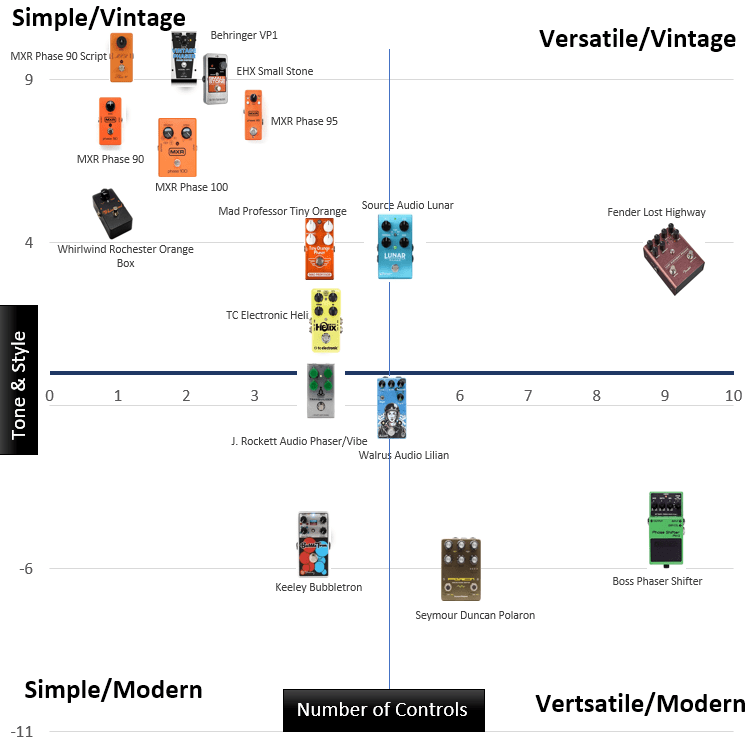
Based on the above graph, here's how we'd break down each category:
Versatile and Modern Phasers
- Boss Phase Shifter
- Seymour Duncan Polaron
- Walrus Audio Lillian
Simple and Modern
- J. Rockett Audio Phaser/Vibe
- Keeley Bubble Tron
Versatile and Vintage
- Fender Lost Highway
- Source Audio Lunar
Simple and Vintage
- MXR Phase 90 Script
- Behringer VP1
- EHX Small Stone
- MXR Phase 95
- MXR Phase 90
- MXR Phase 100
- Whirlwind Rochester Orange Box
- Mad Professor Tiny Orange
- TC Electronic Helix
Bargain or Overpriced
Our second graph measures the price of the pedal and the quality of the manufacturer, or the balance of boutique builders and mass producers. This helps to determine whether a phaser pedal is just cheap and low quality or actually a good bargain with high value. Given the limited number of phaser pedals on the market, this graph yielded no pedals in the "bargain" section of the graph. The Whirlwind Rochester Orange Box and EHX Small Stone come the closest.
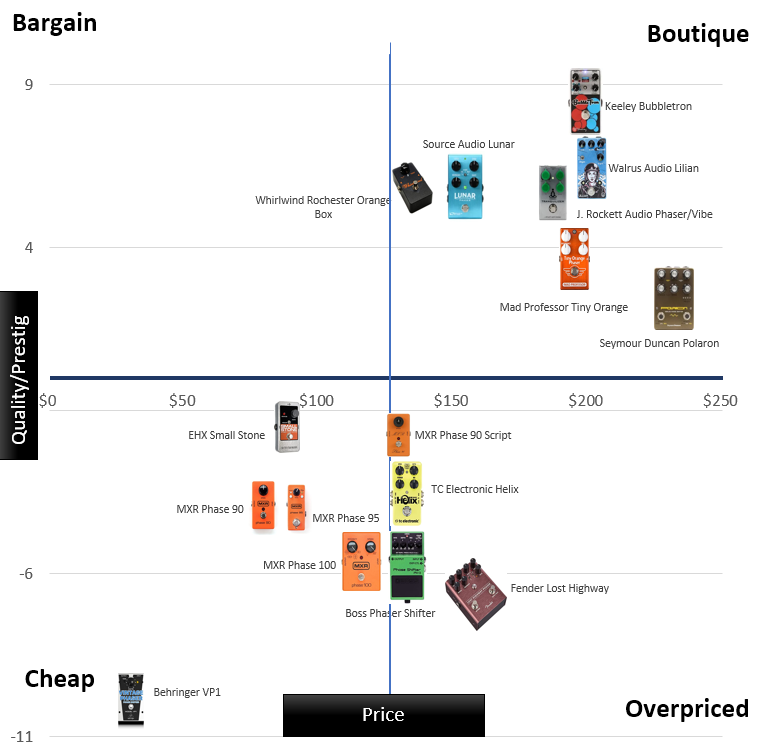
Let's break down each pedal again by the graph. Keep in mind, the line between overpriced and cheap is linear and shouldn't be viewed as an on/off switch. For example, the Boss Phase Shifter, while technically falling on the "overpriced" side of the graph, is quite close to the median, and therefore still a good value.
Boutique Phaser Pedals
- Keeley Bubble Tron
- Seymour Duncan Polaron
- Mad Professor Tiny Orange
- J. Rockett Audio Phase/Vibe
- Walrus Audio Lillian
- Source Audio Lunar
- Whirlwind Rochester Orange Box
Overpriced
- Fender Lost Highway
- Boss PH-3 Phase Shifter
- TC Electronic Helix
- MXR Phase 90 Script
Cheap
- EHX Small Stone
- MXR Phase 90
- MXR Phase 95
- MXR Phase 100
- Behringer VP1
What makes a phaser pedal good or great?
Phaser pedals are primarily characterized by their control, tone quality, circuit type, and price. When assessing phaser pedals, these are the categories we look to in order to determine the "best" or the highest-value options. The tone quality and price are fairly self-explanatory, but let's talk a bit more about controls and circuit type.
Phaser Pedal Controls
By changing the mix or the ratio of in-phase signal to out-of-phase signal, you can alter the speed of the phasing cycle. Speed or “Rate” is the primary control involved with any phaser pedal, which you might notice is the only control on the MXR Phase 90 and the DOD 201.
Other controls might include a level, wet/dry mix or a depth knob. These are common characteristics of other modulation effects as well. Generally speaking, the more control you have, the better your phaser pedal. However, we also need to understand the quality difference between analog and digital phasers.
Analog VS Digital (circuit type)
When comparing phaser pedals the distinction between analog and digital is a significant consideration. Here's an easy summary of the differences between the two:
- Analog: Effect is processed through a physical analog circuit (with actual stages and filters)
- Digital: Effect is processed through a digital signal processor (DSP)
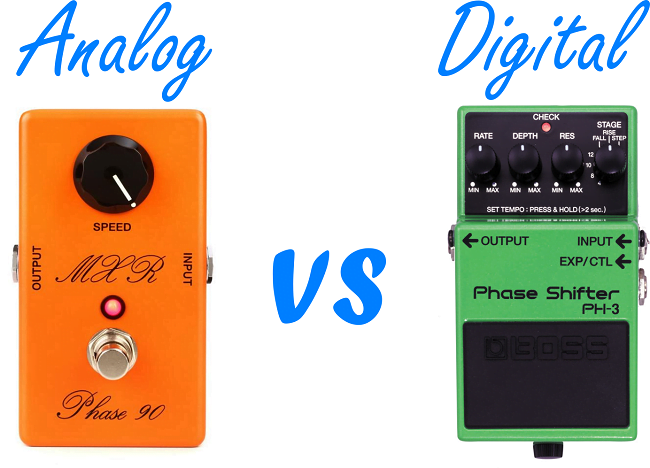
Differences between analog and digital phaser pedals.
Often times the difference between the two - in terms of sound - is subtle, though some might argue that analog phaser pedals (and analog pedals in general) sound better. While that might have been true 20-30 years ago, digital technology has gotten really good at replicating analog circuits.
Today, the difference between an analog and digital phaser pedal is usually quite small. Many digital phaser pedals will have a lot more customization options and versatility in their control system.
For example:
- MXR Phase 90 (analog): Single speed control knob
- Boss PH-3 Phaser Shifter (digital): 7 different modes and a three-band EQ
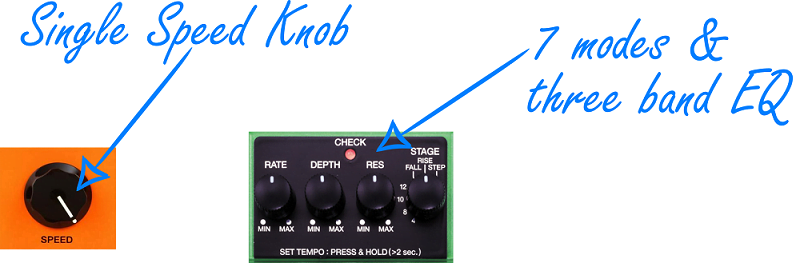
Digital phaser pedals often have more control options.
The trade off is that analog phaser pedals tend to be more expensive with less flexibility, while digital phasers don’t sound quite as good but offer a lot more control. My advice for most players, especially beginners, would be to go with the phaser pedal that offers you more control. Yet, per our recommendations in the above table, there are plenty of good options on both the analog and digital side of the fence. Otherwise, you could break preferences down like this:
- If you value control and variety, go with a digital phaser pedal
- If you value a warmer tone and more organic, vintage-sounding effects, go with an analog phaser pedal
How Much to Spend
Because the phaser pedal is such a common and standardized effect, those who would consider themselves “casual” users, should avoid going too much over the $100 mark. On the other hand, someone who expects to use their phaser pedal a lot, making it an integral part of their sound, would be justified in spending $200 and beyond.
For most, a phaser will only be useful in certain situations. While it’s a great effect to own, it’s not worth over-spending if you aren’t planning on using it a lot. Aim for the $50 to $150 price range.
Things to Consider When Buying
In a lot of situations, your use for a phaser pedal will be limited unless you just really like the phaser sound. As I’ve explained, a lot of modern guitar players use it as a subtle additive, particularly when the note-count of a lick is low. Having an effect makes simpler melodies more full.
Before you decide how much money you want to spend, it would be wise to think about how and when you might actually use a phaser. If it’s the typical, here and there, you’re better off to avoid spending too much. Go with one of the phaser pedals under (or near) $100.
If you plan to use it all the time, a heftier investment like the Empress or Red Witch offering might be in the cards. Just plan ahead so you don’t end up with a $300 investment that, for the most part, collects dust on your pedalboard.
Thoughts or questions?
Do you have thoughts about our best phaser pedal list? How about inclusions or exclusions? Let us know about it in the comments section or if there were other phaser pedal reviews you were hoping to see.
More Guitar Pedal Roundups
Written by Bobby Kittleberger on Effects & Roundups
Written by Bobby Kittleberger on Effects & Roundups
We link to products on Sweetwater that help support our site and keep the lights on. If you click through our orange buttons, we might earn a commission at no extra cost to you. Thank you all for your generous support over the years! ~ Bobby and Danielle
Our disclosure↬


DOD Phasor FX20 ! Excelent !
Hey Julio – I assume you’re referring to this box? https://reverb.com/p/dod-phasor-fx20
It’s my understanding that the Phasor 201 is the newer iteration of that particular pedal line, but I agree those old ones are great. I also liked the FX20C: https://reverb.com/item/31863100-dod-fx-20c-stereo-phaser-usato
I got the DOD Phasor FX20 and used for years. Nice for funky stuff, also for lead work.
Nice. I’m always tempted to snag those up on Reverb.