
What does a proper line array system for a 2,000-seat hall actually require, and how do I avoid underspending or overspending?
For those who don't know me, my name is Bobby Kittleberger. I'm a guitar player and a sound tech with over 20 years of experience in this industry. If you have questions, you can get in touch with me directly, via email. Happy to help.
Understanding the Acoustic Demands of a 2,000-Seat Hall
A 2000-seat hall can be in a lot of different contexts - church, school, etc. But we need to establish some general consistencies here so you know what I am assuming:
- Typical seating depth: ~100–160 ft (30–50 m)
- Ceiling height: often 30–60 ft
- Mixed audience zones (floor + balcony)
- Reverberation time (RT60) usually higher than ideal
At this scale, your coverage consistency matters a lot more than raw loudness. Because even loud systems can lose intelligibility in certain parts of a room that size, if there's poor vertical control.
Typical starting ranges (per side):
In a typical 2,000-seat hall, a flown left/right line array system will often use 6–10 full-range line array elements per side, depending on room height, seating depth, and balcony coverage. Each element is an individual cabinet, with the total number chosen to provide consistent vertical coverage rather than simply higher volume.
So a standard left/right flown system would be:
- Left array: 6–10 cabinets
- Right array: 6–10 cabinets

Six to 10 elements (speakers) feels like a lot, but it gets you consistent coverage, not simply additional volume/loudness.
12–20 total full-range line array cabinets
Each “element” is one enclosure, not one system.
Variables include (but are not limited to):
- Trim height
- Throw distance
- Desired SPL (speech vs music-heavy)
- Balcony coverage needed?
Why Not Just Use Fewer, Louder Boxes?
With too few elements:
- Vertical dispersion widens
- Front rows get blasted
- Rear seats lose clarity
- Ceiling reflections increase
- Intelligibility drops
Line arrays work because: Multiple smaller sources behave as a controlled line, not a point.
Professional Line Array Systems Commonly Used in 2,000-Seat Halls
As far as my line array recommendations, I'd almost always go with a bundle to start with, which will include multiple speakers already in an array and sometimes a subwoofer at the bottom. Sweetwater typically offers these bundles and has a fantastic sales/support staff that can offer additional consulting if needed.
Here one I'd start with:
Meyer Sound LINA Compact Line Array and 750-LFC Subwoofer System
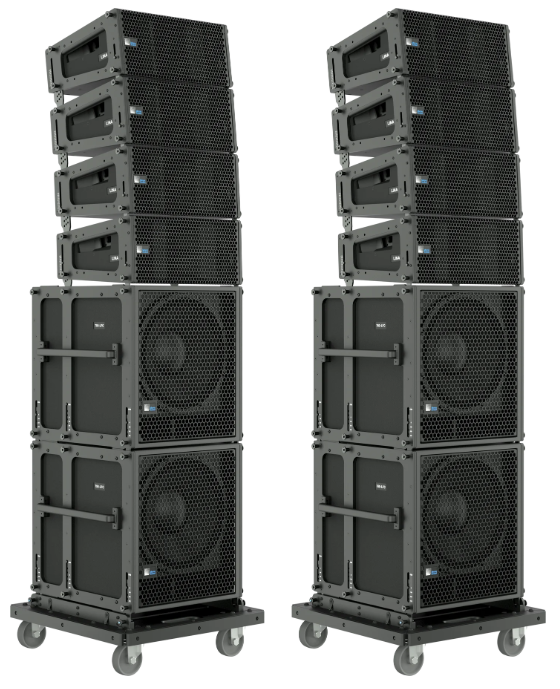
This bundle includes the following:
- 4 top array speakers on the left
- 4 top array speakers on the right
- 8 total full-range cabinets in the system
- 2 subwoofers per side
Now, what about adhering to our 6-10 array speaker requirement?
Many product images and entries include (or show) arrays with 3–4 cabinets per side, which is common for portable or short-throw applications. In a permanent 2,000-seat hall—especially one with balconies or long seating depth—we should try to stick with our 6–10 full-range line array elements per side. Here's a more thorough breakdown.
- 4 per side → small venues / short rooms / portable use
- 6 per side → entry-level 2,000-seat halls with favorable geometry
- 8–10 per side → long rooms, balconies, music-heavy use
This means that to be in the ballpark of a 2000-seat hall, you would probably need to add elements (speakers to each side of this particular array).
Here are a few common scenarios:
- A hall adds a balcony → add elements
- Intelligibility complaints in rear seats → add elements
- More music-heavy programming → add elements
- Original budget constraints → start smaller, scale later
That scalability is one of the biggest justifications for line arrays in permanent venues.
So in our Meyer Sound LINA recommendation, you would add more single loudspeakers to expand on your additional setup. You can buy one Meyer loudspeaker element at a time.
Scalability is one of the biggest justifications for line arrays in permanent venues.
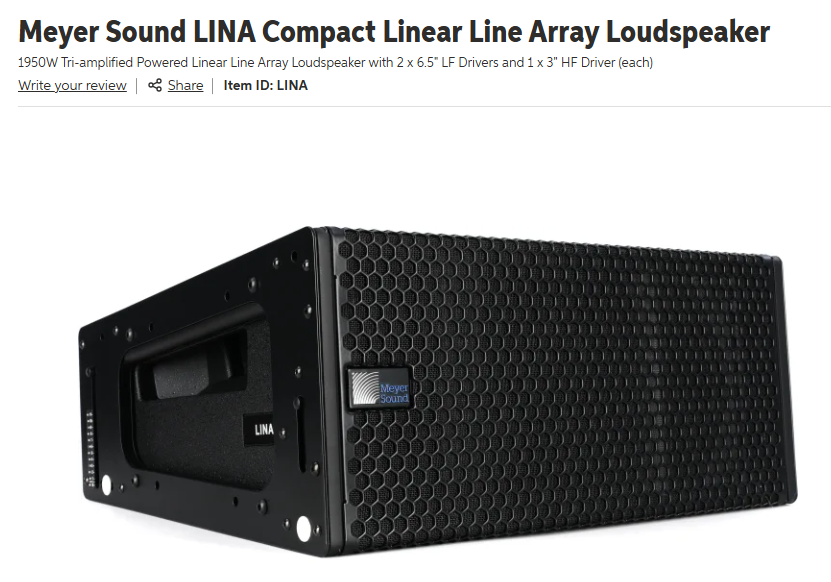
You can add loudspeakers to any of your arrays.
So in this scenario you would buy the following:
- The Meyer bundle
- Two Meyer linear line array speakers for each side (4 total)
You can mix brands if you want, but I'd highly recommend keeping everything in the same brand. Meyer pairs with Meyer, JBL with JBL, etc.
QSC LA108 1,300W Array Speakers and Sub Ground Stack System

Like the Meyer Sound setup, you can easily add to these QSC arrays. They're more affordable than the Meyer system, though come with one less sub and loudspeaker on each side. The Meyer is also higher wattage (louder), but again, loudness is not the primary concern here.
Here's the QSC line array speaker that's part of the bundle. You could always start with the bundle and add as (if) needed.

You can add QSC active line array speakers as needed.
If you do add speakers (or subwoofers), here's a look at some of the hardware you'd have to add as well:
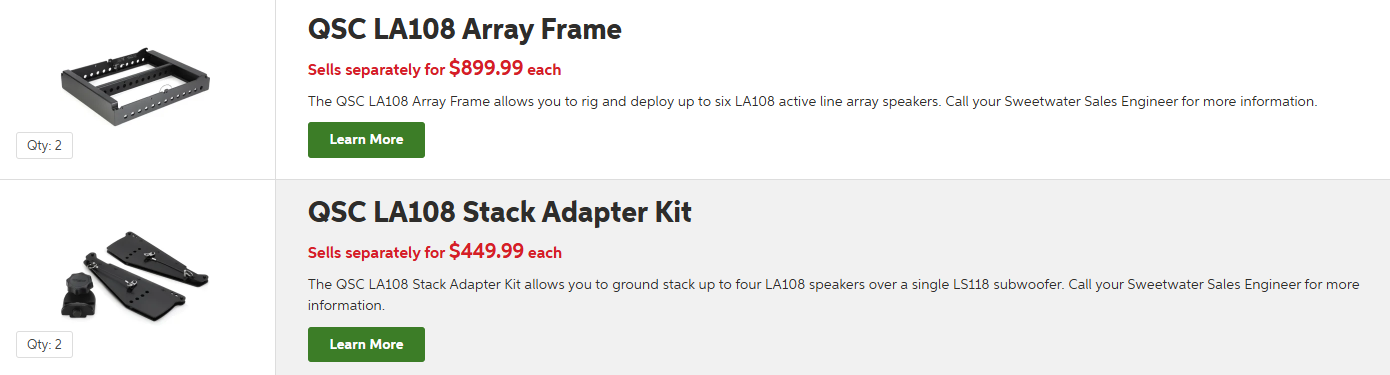
Hardware for setting up QSC speaker arrays.
All of these are available on the same page as the bundle I linked to via the orange button above: Speakers, subs, hardware, and even the required cabling.
JBL SRX910LA 8 Line Array 4 and Subwoofer Ground PA System
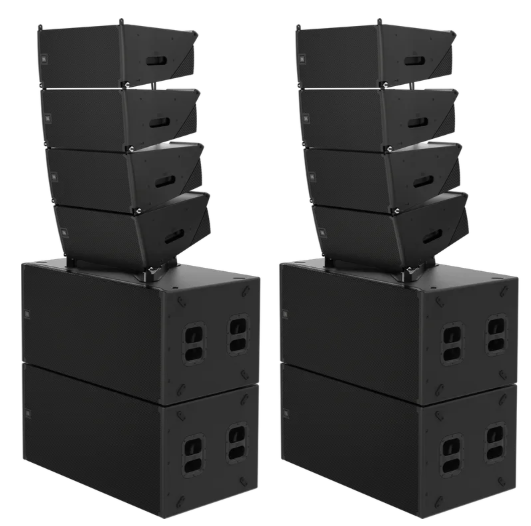
This JBL system has a lot of power and the flexibility to be set up on the FLOOR if that's preferable to a rigging or if your stage has risers on the sides where speaker arrays can be placed.
The JBL SRX910LA 8 Powered Line Array 4 Powered Subwoofer Ground PA System bundle is a system you could set up on the ground, and it’s designed exactly for that flexibility.
Note that you can use this hardware included in the system to adjust the angle of the array as it rests on the subwoofers:
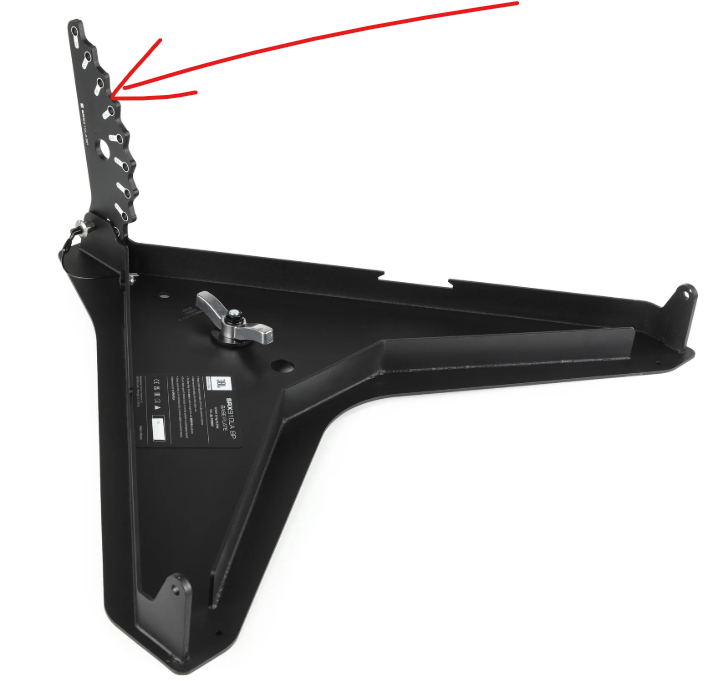
Mechanism for adjusting the angle of the speaker array (rests on the subwoofers).
It isn’t a permanently flown installation by default (although it can be integrated into permanent installs with the right rigging), which makes it suitable for venues that either:
- Don’t have rigging points, or
- Want a portable or ground-stacked configuration for events, rentals, or multi-purpose use.
Horizontal & Vertical Coverage Considerations
Here are a few quick bullet points to consider when it comes to horizontal and vertical coverage of your space:
Horizontal dispersion:
- Common ranges: 80°, 90°, 100°
- Narrower = longer throw, less wall spill
- Wider = fewer arrays, more sidewall energy
Vertical control:
- The real benefits of line arrays
- Proper splay minimizes:
- Ceiling reflections
- Front-row hot spots
- Back-row dropouts
Subwoofers: How Much Low End Does a 2,000-Seat Hall Actually Need?
Personally, I'd argue that four subs is plenty for a room this size. However, if you're going to be music-heavy, then maybe you could add to that count. Even then, I'd start with two per side (maybe even one per side) and only add if you feel like it's necessary. Speech-focused rooms, even at a 2000 seat size, will be fine with less focus on low-end. If that's your situation, start with one per array and go from there. You can always order more.
Typical guidance:
- 4–8 dual 18” subs (ground-stacked or flown)
- Cardioid or end-fire arrays recommended indoors
- Speech-focused venues may need fewer subs than expected
Excess low-end energy reduces intelligibility in reverberant rooms.
System Processing, DSP, and Control: Where Performance Is Actually Won or Lost
At the scale of a 2,000-seat hall, loudspeaker performance depends as much on processing, tuning, and control as by the loudspeaker hardware itself. It's not hard to get a "good" speaker, but it's definitely hard to get the setup right.
Dedicated System DSP vs Mixer EQ
One of the most crucial things to keep in mind when you're thinking through this is the difference between system DSP and EQ.
- System-level DSP (loudspeaker processing)
- Mixer EQ (content shaping)
Mixer EQ is for program material while system DSP is for room correction, alignment, and protection. You cannot fix a poorly tuned system at the mixing console. As such, a proper system should utilize the following:
- Loudspeaker-specific DSP
- Crossover management
- Limiting and protection
- Time alignment between arrays and subs
Getting this right up front helps you avoid the trap of sounding great during an install but then oddly not-so-great later. In simpler terms, it mitigates (as much as possible) inconsistent results between events.
You cannot fix a poorly tuned system at the mixing console.
Why Processing and Tuning Often Matter More Than the Speaker Brand
Reputable manufacturers all build capable hardware at this level. You won't find a quality differences of consequence. There can be differences in outcome, but they are almost always going to be due to the following:
- System design
- DSP configuration
- Room interaction
- Installer competence
Rarely will it be an issue of poor product quality. In large venues, a well-tuned mid-tier system will often outperform a poorly tuned premium system. This has some profound implications for you as the buyer:
- Budget for professional commissioning
- Prioritize system DSP capabilities
- Don’t evaluate systems based on spec sheets alone
- Determine who will tune and support the system long-term
In large venues, a well-tuned mid-tier system will often outperform a poorly tuned premium system.
Rigging, Safety, and Structural Considerations
IMPORTANT: I am not a structural engineer. You absolutely must consult qualified engineers and those who have experience physically installing these systems. Again, Sweetwater consultants are a great starting point. As such, I must reiterate that this content is for educational purposes only and Guitar Chalk bears no responsibility for installation results.
In a 2,000-seat hall or otherwise, loudspeaker rigging is a structural, safety, and liability issue. Whether a line array is flown or ground-stacked, the physical deployment of the system must be engineered with GREATER care than the audio design itself.
Flown vs Ground-Stacked Arrays
Line array systems can be deployed in two primary ways:
- Flown arrays, suspended from ceiling structure or truss
- Ground-stacked arrays, built upward from the floor or subwoofer base
Flown arrays are common in permanent installations because they:
- Provide ideal vertical coverage
- Reduce visual obstruction
- Minimize audience interaction with equipment
Ground-stacked arrays are sometimes used where:
- Rigging points are unavailable
- Portability is required
- Temporary or multi-use deployments are common
However, for long-throw indoor venues, flown arrays typically offer greater coverage consistency and safety margins when properly engineered.
Structural Load and Weight Calculations
Every line array cabinet has a published weight, and when multiple elements are combined (or added to an existing bundle), the total suspended load increases quickly.
Key considerations include:
- Total hang weight (including rigging hardware)
- Dynamic loads caused by movement or vibration
- Safety factors required by building codes
- Load limits of truss, beams, or ceiling attachment points
For permanent installations, structural load calculations should be:
- Reviewed by a qualified structural engineer
- Approved before any equipment is installed
- Documented for insurance and liability purposes
No array should ever be flown based on manufacturer ratings alone without verifying that the building structure can safely support it. Input from a qualified structural engineer is by far the most important part of this process.
Certified Rigging Hardware and Standards
Professional line array systems use manufacturer-approved rigging hardware, designed specifically for the cabinet geometry and load characteristics.
Best practice includes:
- Only using certified fly frames, pins, and suspension hardware
- Following manufacturer-specified maximum array lengths and angles
- Complying with applicable safety standards and codes
- Avoiding improvised or third-party rigging solutions
Rigging should be performed or supervised by technicians trained in professional audio rigging practices, not general labor or volunteers.
Inspection, Maintenance, and Long-Term Safety
Once installed, rigged systems are not “set and forget.”
Responsible venues plan for:
- Periodic visual inspections
- Hardware wear monitoring
- Re-verification after system expansion or modification
- Documentation of maintenance and service history
Any time additional line array elements are added, the system should be re-evaluated for:
- Structural load
- Rigging limits
- Array geometry and aiming
This is especially important for venues that scale their systems over time.
Why Rigging and Safety Impact Purchasing Decisions
For schools, churches, and civic venues, the consequences of improper rigging extend far beyond sound quality.
Poor rigging decisions can result in:
- Safety hazards
- Insurance complications
- Legal exposure
- Costly retrofits or system removal
As a result, rigging capability, documentation, and professional support should be considered a core part of the system cost, not optional add-ons.
Speech Intelligibility vs Music Performance
The next most important question to answer is: What is our system primarily expected to reproduce? Systems optimized for clear speech behave differently compared to those optimized for full-range music performances. Understanding this distinction is critical when specifying a line array system.
Why Speech Intelligibility Matters at This Scale
For assemblies, presentations, worship services, and spoken-word events, speech intelligibility is the most dominant performance metric.
Clear speech requires:
- Strong midrange presence
- Consistent coverage across seating areas
- Controlled reflections from ceilings and walls (unwanted reverberations)
- Minimal low-frequency buildup
In large, reverberant spaces, excessive volume does not improve clarity. In fact, pushing a system harder often reduces intelligibility by increasing reflected energy in the room.
This is why professional systems for speech-heavy venues are designed to emphasize control and consistency rather than maximum output.
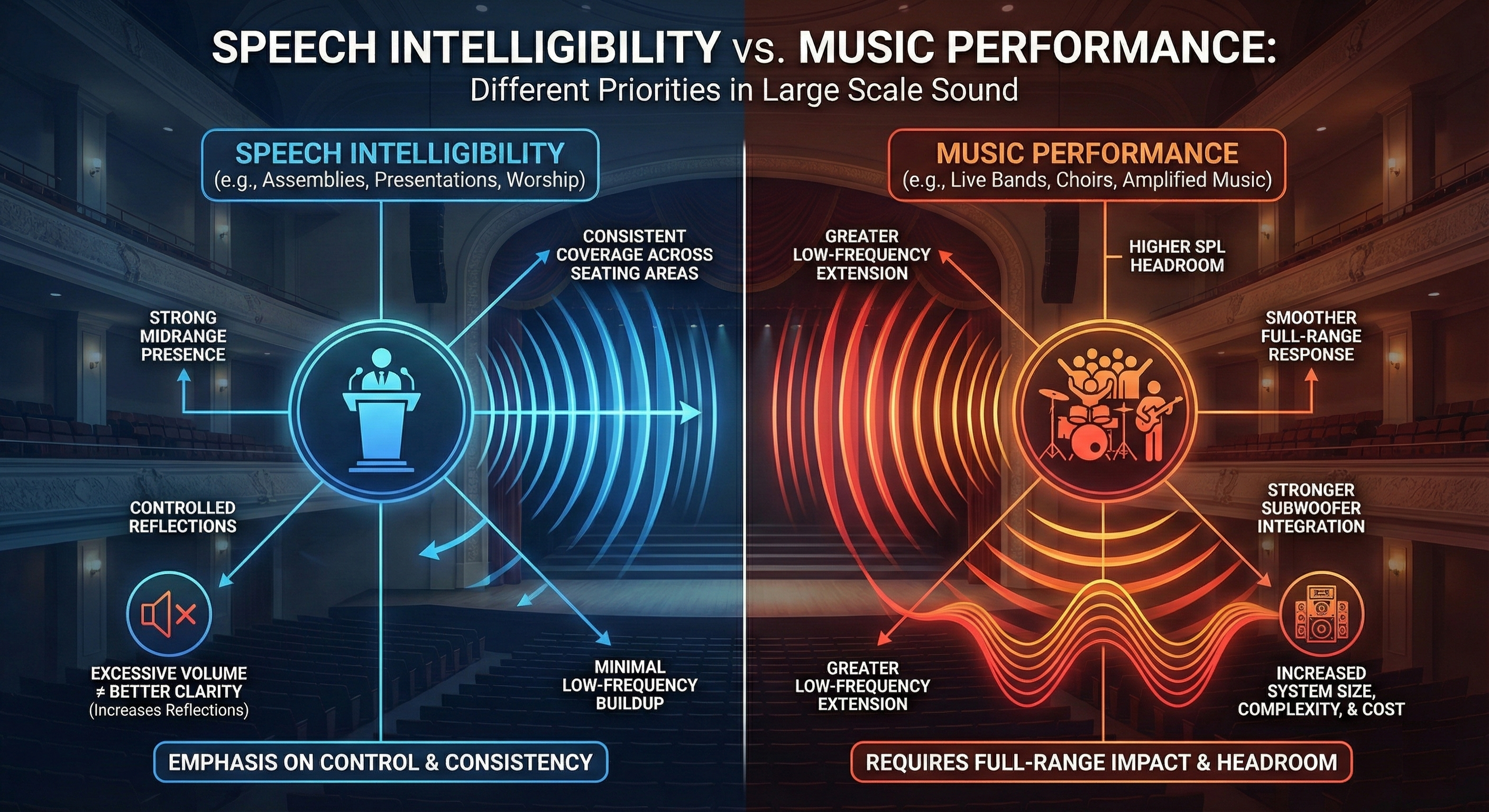
You'll have different priorities depending on the use of the room. Unfortunately, it adds a layer of nuanced complication, but it's worth taking the time to get it right.
Music Performance Has Different Priorities
Music places different demands on a system, particularly for:
- Live bands
- Choirs and orchestral performances
- Contemporary worship or amplified music
Music-focused systems typically require:
- Extended low-frequency
- Higher SPL headroom
- Smoother full-range frequency response
- Stronger subwoofer integration
These requirements often increase system size, complexity, and cost — especially in large rooms. Subwoofers can run up the cost of a line array quite a bit.
The Tradeoff: Optimizing for One Can Compromise the Other
A critical reality of large-venue sound is that no system can be perfectly optimized for both speech and music without compromise. This makes it especially difficult for churches where music and spoken word are both consistently part of a room's use, often within the same event.
Potential problems include:
- Systems tuned for powerful low end can mask speech clarity
- Systems tuned tightly for speech may sound thin for music
- Aggressive EQ for music can reduce articulation for presenters
Professional system design balances these competing needs based on actual usage, not ideal scenarios.
How Line Arrays Help Manage the Balance
Line array systems offer advantages that help navigate this tradeoff:
- Controlled vertical dispersion improves speech intelligibility
- Modular scalability allows systems to grow as music demands increase
- Precise DSP enables different tuning profiles for different events
Many venues operate with:
- A primary tuning optimized for speech
- Presets or scenes that enhance musical performance when needed
This approach preserves clarity but still affords you some flexibility.
Common Misconceptions About “More Power”
One of the most common mistakes in large halls is assuming that: If the system is powerful enough, it will handle everything.
In reality:
- Intelligibility is governed by coverage and reflections, not wattage
- Excessive subwoofer energy often reduces clarity
- Poorly controlled systems create listener fatigue, not engagement
For speech-first venues, restraint and control outperform raw output.
Choosing the Right Priority for Your Venue
When evaluating line array systems for a 2,000-seat hall, buyers should be clear about:
- The percentage of speech-driven events vs music-driven events
- Acceptable compromises for secondary use cases
- Budget allocation between full-range elements and subwoofers
- The role of DSP and tuning in adapting the system over time
Many schools, churches, and civic halls ultimately prioritize speech intelligibility first, with sufficient musical capability to support occasional performances.
Quick Decision Checklist: Defining the Right Performance Priority
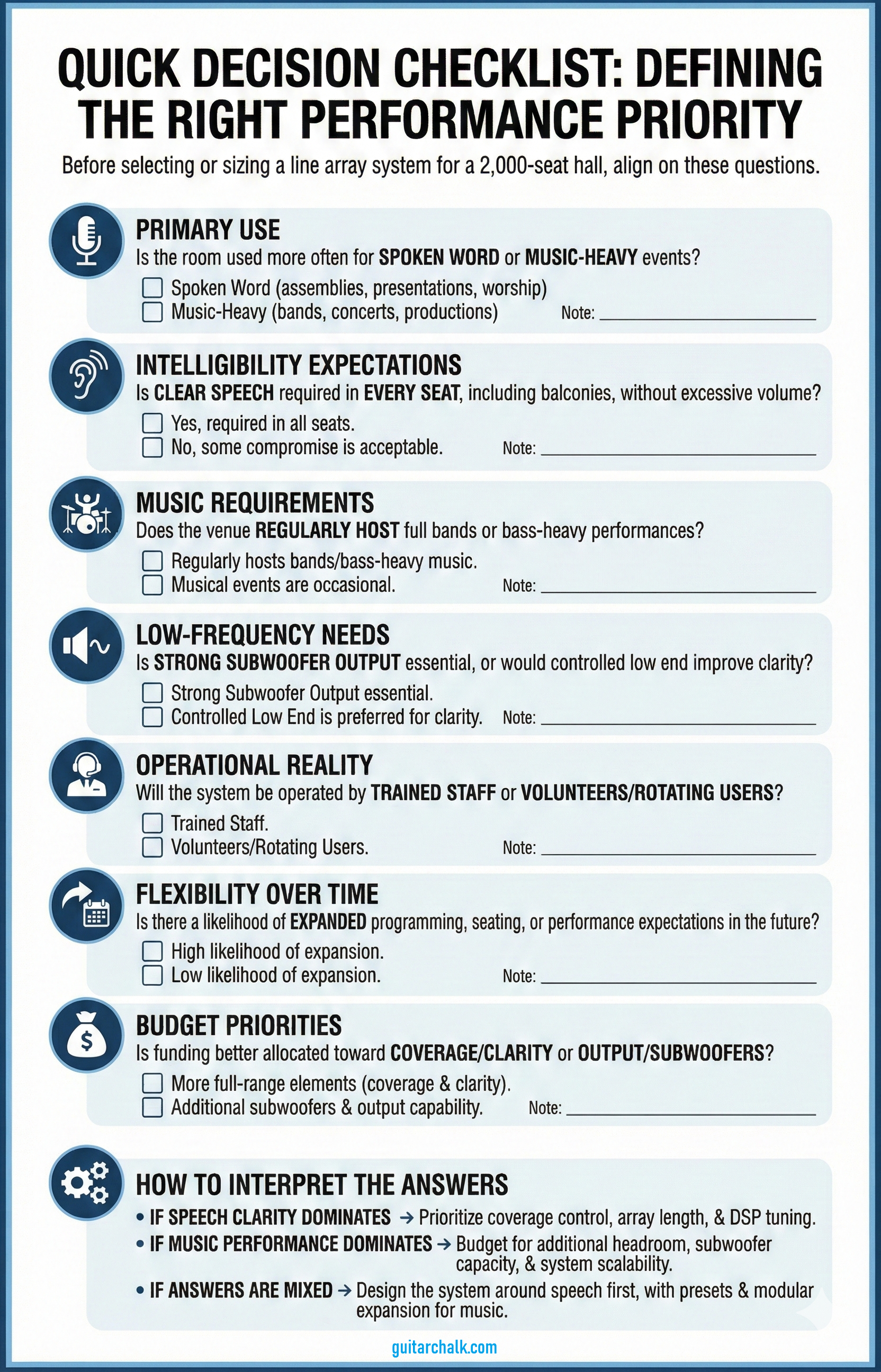
Room use checklist. Download the full checklist.
Systems that sound impressive during music demos but struggle with everyday speech often create long-term dissatisfaction. Systems designed for clarity also tend to perform reliably across a wider range of events.
Budget Ranges (Reality Check)
Speakers and hardware are the main cost, but installation, tuning, and rigging should be considered as well. Your total expenses will typically fall in one of these three price ranges:
- Entry professional: $40k–$70k
- Mid-tier touring-grade: $70k–$120k
- Premium systems: $120k–$200k+
Final Recommendation: How to Choose the Right System
To summarize, here's the process you'll go through to get your line array speaker setup nailed down:
- Start with room dimensions
- Define primary use (speech vs music)
- Model coverage
- Budget for tuning
- Work with an integrator
Once again, if you have questions, feel free to reach out via email or even the comments section below. If I can't help you personally, I know several guys who can jump in and provide additional knowledge.
We link to products on Sweetwater that help support our site and keep the lights on. If you click through our orange buttons, we might earn a commission at no extra cost to you. Thank you all for your generous support over the years! ~ Bobby and Danielle
Our disclosure↬


Comment Policy: You're down to leave a comment? That's awesome. Keep in mind that comments are moderated and rel="nofollow" is in use. Please avoid any spammy keywords or a domain as your name, otherwise your comment will be deleted. Let's stay on topic, keep questions relevant and have a meaningful conversation. All the best.