
Universal Audio Ruby '63 Review: Quick Summary
Verdict and Review Summary
The Ruby '63 is modeled to sound like a British tube amp being mic'd and recorded in a live room, and it nails this sound perfectly. While that's a limited style scope, it's a really addictive pedal with a wail, and sweetness to it if you're into the '60s British amp tones.

BEST FOR: Recording, amp replacement, classic rock, blues, clean tone flexibility.
TONE
88
SETTINGS
90
VERSATILITY
93
PRICE/VALUE
82
- You rarely hear a digital pedal sound this natural
- Can function as a boost/gain pedal or an amp replacement
- Unique blend of controls
- Wide range of tones that really add variety to your clean sounds
- Very sweet and warm sound qualities
- Great for blues and single coil pickups
- A little expensive for this effects category (boost/overdrive)
For an amp pedal, I was surprised at the variety I was able to get from the Ruby '63. It just kept producing interesting sounds and it didn't need a ton of gain to do the job.
It's certainly not a heavy amp tone, but it does a very convincing job of modeling the sound of a '60s tube amp being recorded in a live room.
It uses something called Dynamic Room Modeling technology so that the pedal can create a sound to emulate being in a room with a mic'd amp, which brings a lot of variety to your clean tone.
This makes for some really interesting sounds and a fantastic recording tool.
I'll cover the details in my full Universal Audio Ruby review.
Compare to Other UA Pedals
This is the third Universal Audio pedal we've tested. They have a line of six stompboxes (at the time of publishing this review), so we've built this table for comparing the three pedals we've reviewed and one more that looks interesting to us.
Pedal | Name | Rate | Shop |
|---|---|---|---|
 | Ruby '63 | 88.3 | |
 | Astra | 91.8 | |
 | Dream '65 | 90.0 | |
 | Reverberator | 90.2 |

The Ruby '63 uses emulation and a form of room modeling technology that recreates the sound of a tube amp recorded in a live room.
Ruby Price Guide
Prices updated Fri, August 21st, 2026.
Pricing from Sweetwater

Tone quality: Cleans, gains, and vibrato
With some breakup get a lot of choppiness and your notes will have a nice scrape to them, which sounds great with partial string mutes. The scrape is more balanced in the Normal amp mode, which is actually limited to a one-band EQ, controlled by the Cut knob. It's definitely brisk and bluesy, particularly good for a Stratocaster or Telecaster single coil arrangement.
Normal Amp Model
I found the Normal amp model to just be less aggressive overall. It has a smoothness to it and it's a lot easier to tame. I'd probably recommend this mode for more rhythmic playing styles if you're on the higher gain side, but with clean tones all styles are fair game.
Brilliant Amp Model
The Brilliant amp model is where gain gets brighter and more crisp. You do, however, have more control over this sound with the two-band EQ engaged. If you want to mellow out the brightness, it's pretty easy to do so.
To get that additional gain, it models an extra tube which pushes the breakup harder. If you run the volume up on the Brilliant amp model you'll get a fairly heavy distortion sound, though it's still very bluesy.
Cutting the gain and bass down on the Brilliant model gave off an incredibly satisfying blues sound.
The Cut and Treble were both set at about 10 o'clock, and I was using the Blue speaker cab model.
Some of the settings I tested were a little too bright for my taste.
But that's a preference issue and not a quality concern.
Vibrato mode
Vibrato mode puts a layer of vintage-style modulation over an amp emulation that's similar to the Brilliant channel. Again, you're getting a very natural, tube-like vibrato sound that almost sounds like it has a little rust to it. Especially for country tones, this mode sounds great with a lot of subtlety, further expanding your options for clean tone spruce ups.
Ruby '63 Demo Video
For the demo video I'm turning things over to Bonedo. We did our own demo for this pedal, but - quite frankly - it sucks. Bonedo never lets us down. His demos are always better than mine.

The in-the-room sound is the headline feature. All the amp and speaker models fall under that banner.
Control
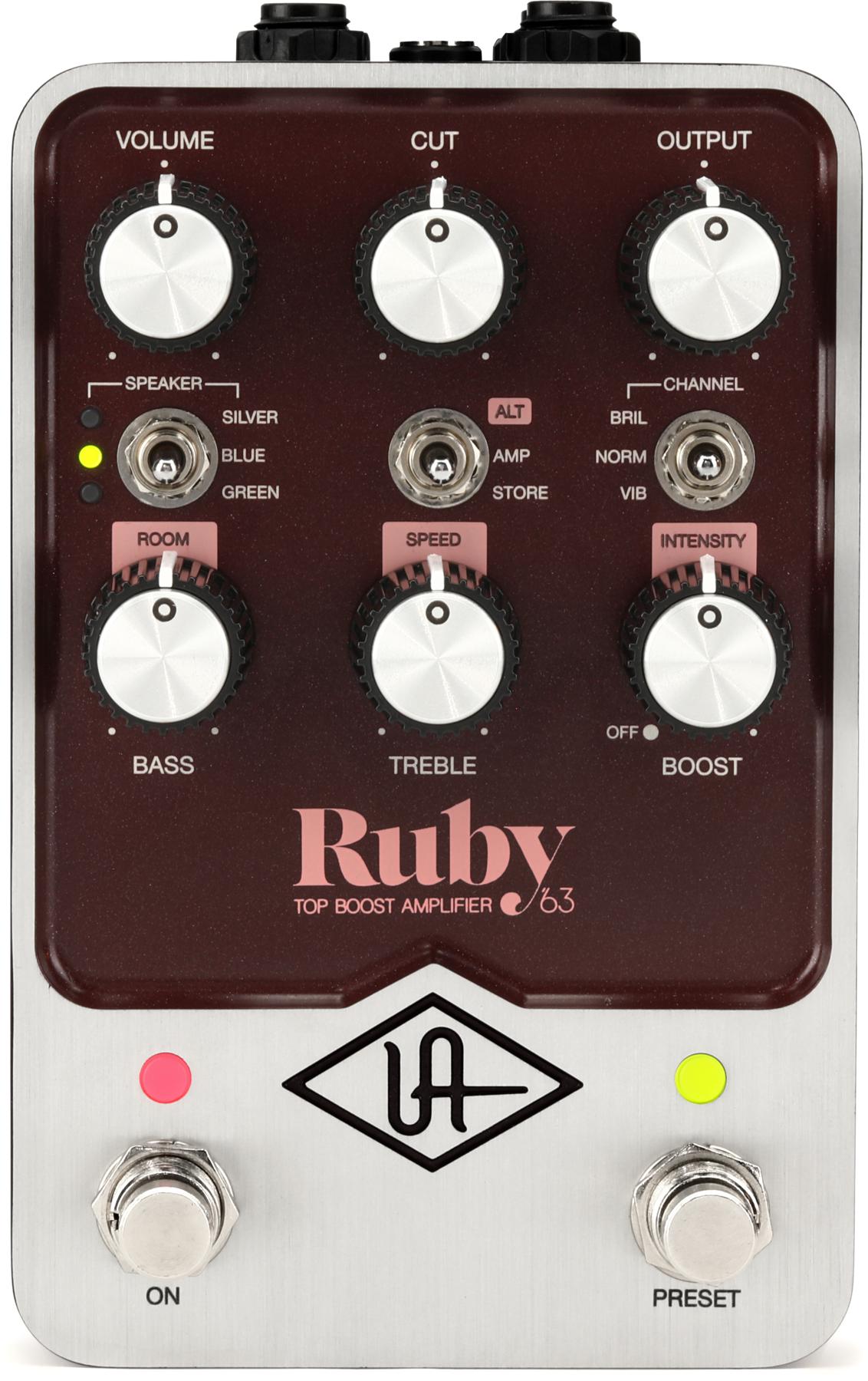
With the vibrato mode you have three controls:
- Room
- Speed
- Intensity
This gives you elements of modulation and ambience to control when you're using the Vibrato amp mode. Use the ALT switch to adjust these settings. As I mentioned, the Normal amp model is limited to a one-band EQ with the cut knob. Thus, volume, output, and boost controls are going to be your main variables.
To increase gain I just rolled the output down and pushed the volume up.
I could get everything from subtle breakup all the way to a much thicker and crunchier sound. It still wasn't modern or metal, but that's not what this pedal is for anyway.
For the Brilliant and Vibrato amp modes, you have the two-band EQ added back and a little more flexibility. I'm guessing this is the mode most of you will be more interested in, just because it seems to offer more variety and a more unique model, especially serving as the base tone for the Vibrato channel.
Note that the speaker cab models are available regardless of the amp mode. To me, the differences here are subtle, unless you're looking for a very specific tone.
To my ear, I was pretty happy with the Blue speaker mode.
You can mix and match as you see fit.

There's a lot of variety between the three amp modes, speaker cabs, and control scheme.
Price and Overall Value of the Ruby
There are three different approaches that I typically see pedal manufacturer's take when setting their prices.
- Across the board fluctuation
- A price range for a series, with fluctuation depending on the pedal within that series
- Price range set and largely static for each pedal in an entire series
Universal Audio has settled on option number three, having priced all of their pedals around the same $400 mark. This is probably my least favorite pricing model, though it's fair to assume the same level of overhead goes into each UA pedal, since their inventory is limited.
But generally speaking, I like to see gain-focused pedals priced a little lower than others, because they just tend to be easier and less complex to produce. Obviously, that is not the case here, and I can't know why for sure. But it's certainly not a deal breaker. I would just be happier with the Ruby price at $350 and the Golden Reverberator's price at $400.
The Ruby '63 isn't cheap, but it's in line with the rest of Universal Audio's pedal inventory.
Best fit for the Ruby '63
You need to decide how much the in-the-room sound matters to you. If you're into that, this is one of the only pedals I know of that can deliver it. For those buying this pedal and expecting something different, or aren't that excited by the live room emulation, there are far better options for you.
It's this emulation that's going to be the most noticeable feature and the biggest draw of the Ruby '63. You should also be specifically be looking for solutions to clean tone doldrums, and perhaps an amp replacement, or just an amp side kick to help get you some more tone variety. Blues, classic rock, church worship music, and jazz are all good style candidates. I'd also recommend it primarily to upper-tier intermediate and advanced players.
What about a power supply?
The Universal Audio Ruby '63 uses a typical 9V DC power supply. Nothing fancy. Note that it does not include one with the purchase, but will work with any 9V power supply connection, either a single adapter, battery, or something like a Voodoo Lab power brick with 9V outlets.
Warranty
If you buy from Sweetwater they have a two-year warranty that covers parts and labor. The warranty provided by Universal Audio isn't much to write home about. It only gives you one year which starts on the date you buy the product, either directly from them or from a reseller like Sweetwater. From that point, it's only one year, so the Universal Audio warranty will run out before the Sweetwater warranty. If you buy from a different reseller, like Musician's Friend or Guitar Center, check their warranty situation as well.
Review Conclusion
The Ruby '63 is a good example of the innovation and uniqueness that pedal builders are able to put out these days. Digital solutions have gotten so good that we can now have tone quality that rivals analog originals, yet with the flexibility and variety of digital control.
Give some thought to how you feel about the in-the-room sound modeling, and the price.
We can give you the information, but it's up to you to make the call.
If you have questions about our Universal Audio Ruby '63 review or the review process, feel free to reach out via the comments section below.
I'll jump in and help. If nothing else, I can share my experience with this pedal.
Thanks for hanging out with us.
More Walrus Audio Pedal Review
Written by Bobby Kittleberger on Pedals & Reviews
Written by Bobby Kittleberger on Pedals & Reviews
We link to products on Sweetwater that help support our site and keep the lights on. If you click through our orange buttons, we might earn a commission at no extra cost to you. Thank you all for your generous support over the years! ~ Bobby and Danielle
Our disclosure↬


Comment Policy: You're down to leave a comment? That's awesome. Keep in mind that comments are moderated and rel="nofollow" is in use. Please avoid any spammy keywords or a domain as your name, otherwise your comment will be deleted. Let's stay on topic, keep questions relevant and have a meaningful conversation. All the best.