
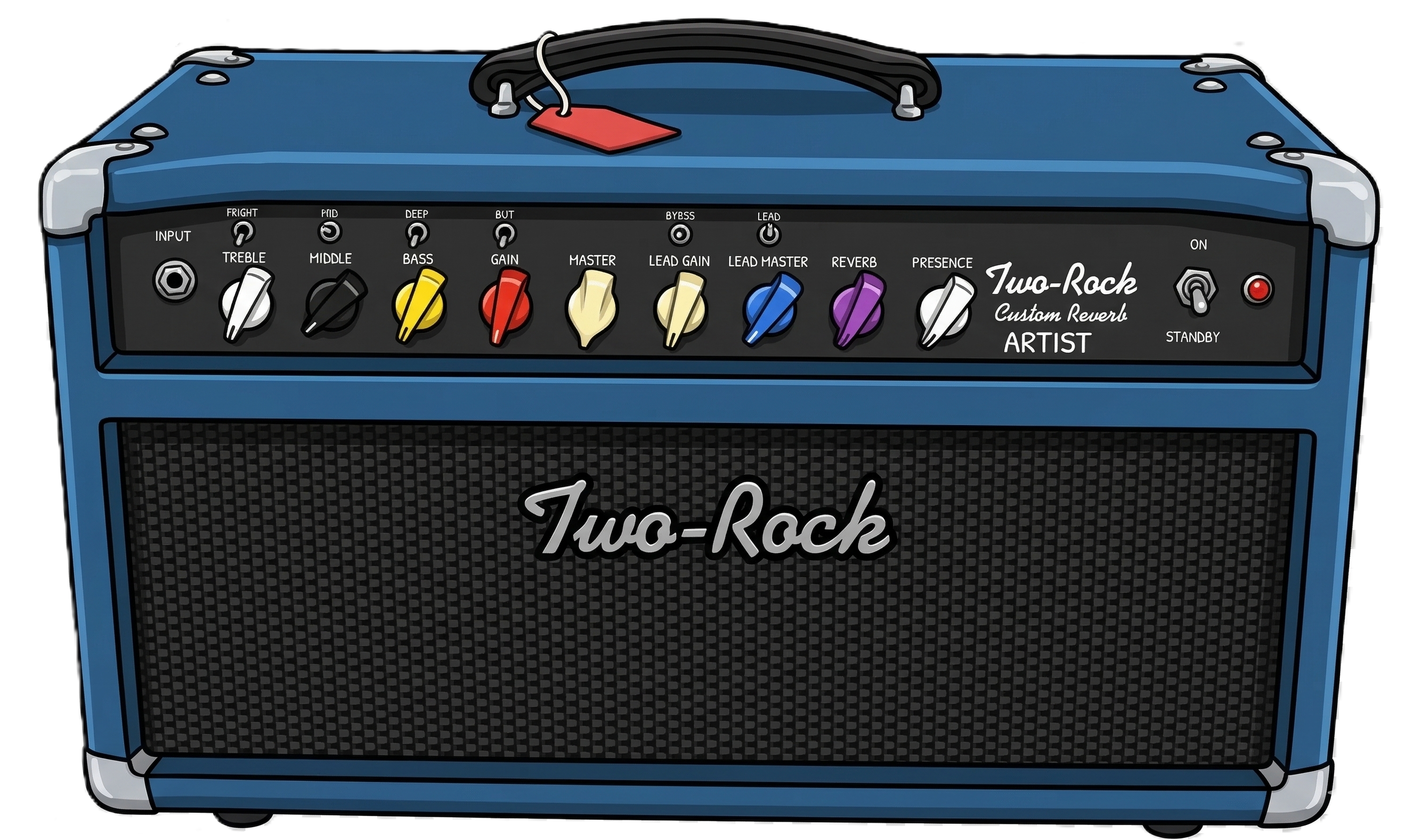
The Two Rock Custom Reverb Signature is one of the most coveted boutique amplifiers in the world — a two-channel, 6L6-driven powerhouse best known for its vast, transparent clean headroom, richly voiced spring reverb, and dynamic touch sensitivity that rewards expressive playing. Made famous by John Mayer and a roster of elite session players, this amp thrives at the intersection of crystal-clear cleans and creamy, harmonically complex edge-of-breakup tones. Its Contour control and three-switch (Bright/Mid/Deep) voicing system give players surgical control over the frequency spectrum, making it one of the most tweakable — and rewarding — amplifiers ever built.
Tone Snapshot
| Characteristic | Description |
|---|---|
| Overall Character | Pristine, wide-bandwidth clean with exceptional harmonic depth and touch sensitivity |
| Gain Level | Low to medium — best from clean to edge-of-breakup; Lead channel extends into light crunch |
| Low End | Deep, controlled, and three-dimensional; Deep switch adds impressive low-mid weight |
| Mids | Balanced and present; Mid switch pushes gain and midrange for singing leads |
| Highs | Silky and extended but never harsh; Bright switch adds glassy sizzle for clean sparkle |
| Best For | Blues, R&B, clean funk, soft rock leads, studio recording, dynamic playing |
Clean Channel Settings (Channel 1)
These settings target the Two Rock's legendary clean platform — full, transparent, and dynamically alive. Use a Stratocaster or Telecaster for maximum sparkle, or a Les Paul for a warmer, thicker character.
| Control | Setting | What It Does Here |
|---|---|---|
| Gain | 4 | Keeps Channel 1 pristine clean with plenty of dynamic headroom; push higher for edge-of-breakup |
| Master | 6 | Gets the power section moving without excessive volume; adjust to room size |
| Treble | 6 | Adds presence and air to single coils without becoming glassy or harsh |
| Middle | 5 | Flat starting point; increase to 6–7 for vocals-forward tones that cut through a mix |
| Bass | 6 | Slightly elevated for warmth and depth without flabbiness |
| Contour | 5 | 12 o'clock = flat frequency response; the ideal neutral starting point |
| Reverb | 4 | The Two Rock's tube-driven spring reverb is lush — a moderate setting keeps it musical |
| Bright Switch | OFF | Keep off with single coils; engage for humbuckers that need extra high-end definition |
| Mid Switch | OFF | Off for clean tones; engage for lead playing to push gain and midrange forward |
| Deep Switch | ON | Shifts low-mid and low-end response for a fuller, more three-dimensional low end |
| EQ1 / EQ2 Switch | EQ1 | EQ1 is the standard voicing; EQ2 shifts to a higher-gain character — use EQ2 on the Lead channel for more crunch |
| Bypass Switch | OFF | Bypasses the tone stack entirely for a raw, uncolored signal — leave off for normal playing |
Lead Channel Settings (Channel 2)
The Lead channel shares all tone controls with Channel 1 but has its own independent Gain and Master controls. Use it for light crunch, singing leads, and expressive blues passages.
| Control | Setting | What It Does Here |
|---|---|---|
| Lead Gain | 5 | Light overdrive with harmonic complexity; ideal for expressive blues and soft rock leads |
| Lead Master | 5 | Matched to clean channel volume for seamless channel switching without a volume jump |
| Mid Switch | ON | Engage for leads — pushes midrange and gain simultaneously for a more vocal, singing quality |
EQ Profile
Balanced full-range profile with slight emphasis on bass and treble for an open, wide-bandwidth sound
Using the Voicing Switches
The Two Rock has six switches on the top row of the front panel — Bright, Mid, Deep, EQ1/EQ2, Bypass, and Lead. The first three are tone-shaping switches that interact with the amp's entire frequency response. Here is how to use all of them effectively:
| Switch | Effect | Best Use Case |
|---|---|---|
| Bright | Adds upper-frequency sizzle and harmonic sparkle | Humbuckers, dark-sounding guitars, or when extra definition is needed on clean passages |
| Mid | Boosts both gain and midrange response simultaneously | Lead channel playing, cutting through a band mix, or thickening single-coil tones |
| Deep | Shifts low-mid and low-end frequency response for added weight | Always worth trying on clean tones — adds dimension and warmth without muddiness |
| EQ1 / EQ2 | Toggles between two different EQ voicings; EQ2 is the higher-gain setting | Use EQ1 for clean and edge-of-breakup tones; switch to EQ2 on the Lead channel when more saturation and midrange push is needed |
| Bypass | Bypasses the entire tone stack, sending a raw uncolored signal to the power amp | Useful for A/B comparison or running the amp completely flat; most players leave this off |
| Lead | Activates Channel 2 (Lead) with its own independent Gain and Master controls | Also foot-switchable via the rear-panel footswitch jack — the primary way to switch between clean and lead voices mid-song |
Getting the Two Rock Tone Without the Price Tag
The Two Rock Custom Reverb Signature costs $4,000–$6,000 new. Here are attainable alternatives that capture the essential character:
| Budget Level | Amp Option | Why It Works |
|---|---|---|
| Budget (~$300–600) | Fender Blues Junior IV or Fender Deluxe Reverb Reissue | Fender's 6L6-driven clean platform shares DNA with Two Rock's voice; warm, dynamic, and touch-sensitive |
| Mid-range (~$700–1,500) | Carr Rambler or Morgan AC20 Deluxe | Boutique-quality clean headroom with similar transparency and harmonic depth to the Two Rock clean channel |
| Premium (~$2,000–3,500) | Two Rock Studio Signature or Tone King Imperial Mk II | Shares core Two Rock design philosophy at a lower price; the Studio Sig is a simplified, gigging-friendly version of the same platform |
Quick Tone Fixes
| If Your Tone Sounds… | Try This |
|---|---|
| Too muddy / undefined | Back the Bass knob down to 4–5, disengage the Deep switch, and raise the Treble to 7 |
| Too bright / thin | Lower Treble to 4–5, engage the Deep switch, and nudge the Contour control counterclockwise (below noon) |
| Too scooped / no mids | Raise Middle to 6–7 and engage the Mid switch on the Lead channel; increase Contour slightly clockwise |
| Reverb sounds washy | Reduce Reverb to 2–3 and back off the rear-panel Drive control; this amp's reverb is very rich and a little goes a long way |
Common Mistakes to Avoid
- Over-cranking the Gain on Channel 1 The Two Rock's clean channel is built for headroom. Pushing Gain past 6 adds breakup but also compresses the dynamic sensitivity that makes this amp special. Keep it under 5 for clean tones and use the Lead channel for anything beyond that.
- Ignoring the Contour control Most players set the Contour and forget it at noon. Try rotating it slightly clockwise for a brighter, more Fender-like presence, or counterclockwise for a warmer, darker sound. It's a powerful active EQ sweep that meaningfully reshapes the entire frequency response.
- Running the Reverb too high The Two Rock's all-tube spring reverb is exceptionally lush and occupies a lot of sonic space. At settings above 6, reverb can wash out note definition — especially on the Lead channel. Keep it at 3–5 for most applications and let the amp's natural bloom do the work.
- Misusing the voicing switches Engaging all three switches simultaneously (Bright + Mid + Deep) creates a chaotic frequency boost with no coherent tonal character. Choose one switch per playing situation: Deep for clean warmth, Mid for leads, Bright for humbucker clarity.
The Two Rock Custom Reverb Signature rewards restraint. Its clean channel is among the most transparent and dynamic in production guitar amplification — keep the Input Gain low, let the Contour and voicing switches shape your tone, and trust the amp's natural character to respond to how hard you play. The three-switch voicing system is the real secret weapon here: a single switch change transforms the amp from a glassy Fender-style clean to a thick, mids-forward lead machine without touching a single knob.
More Amp Settings Content
Written by Bobby Kittleberger on Amps & Settings
Written by Guitar Chalk on Pedals & Settings

Comment Policy: You're down to leave a comment? That's awesome. Keep in mind that comments are moderated and rel="nofollow" is in use. Please avoid any spammy keywords or a domain as your name, otherwise your comment will be deleted. Let's stay on topic, keep questions relevant and have a meaningful conversation. All the best.