
This is a roundup of sound system recommendations for large churches and worship centers, as well as detailed rationale on what to look for and how to navigate this very consequential decision.
What Qualifies as a “Large” Church Worship Center?
I'll define a large worship center or sanctuary in a range between 800 and 3000 seats. We can also establish some other common characteristics:
- High ceilings
- Wide seating
- Balconies
- Reflective surface
In rooms this size, smaller PA systems fail, but not necessarily because they just aren't loud enough. I'm always surprised at how loud small systems can get. Even single speaker setups can shake windows in larger rooms. But the problems crop up with getting even coverage and tuning the audio environment for spoken word and musical performances, which is going to be the single biggest challenge when outfitting an audio system for a church, since spoken word and music are almost always part of the same event. We'll get into the distinction and how to optimize for both.
Help support our work!
We link to products on Sweetwater that help support our site and keep the lights on. If you click through our orange buttons, we might earn a commission at no extra cost to you. Sweetwater is the number one option when it comes to pro audio and we know that because we've been using them and working with them for years. Buying from Sweetwater through us costs you nothing extra and helps support our work. Thank you all! ~ Bobby and Danielle
Our disclosure↬

Primary Goals of a Worship Center Sound System
In a large church, the sound system should be understood as a communication tool. Every design and equipment decision should be made with this in mind, ultimately supporting the church’s ability to deliver its spoken message clearly and consistently.
The most effective systems are those designed around how the space is actually used, and not just how it looks on a spec sheet. Specs are rarely the issue.
Specs are rarely the issue.

Spoken word and consistent coverage are (by far) your top priorities when setting up a sound system in a large church.
Clear, Intelligible Speech
For most worship centers, speech clarity and consistency is the highest priority. Sermons, readings, and spoken transitions must be:
- Easy to understand in all seating areas
- Clear and discernable, even without excessive volume
- Consistent from front rows to balconies
A well-designed system should allow spoken word to feel natural and effortless, even in large or reverberant spaces.
Even Coverage for the Entire Congregation
A strong sound system delivers:
- Similar volume and tonal balance in every seat
- No “hot spots” near the front
- No weak or muddy areas in the back, in the corners, or under balconies
Consistency across the room helps unify the worship experience and reduces the temptation to “mix louder” to compensate for problem areas.
Musical Impact Without Overwhelming Vocals
Modern worship often includes full bands and dynamic music, but musical energy should not overpower clarity. Unfortunately, setting up a system to be optimized for live music is different than optimizing for spoken word. Churches are in a particularly difficult spot, since they have to do a lot of both.
To that end, an effective church sound system:
- Supports musical impact and emotional engagement
- Preserves vocal intelligibility during worship songs and sermons
- Maintains balance between instruments and voices
Speech Intelligibility vs Musical Impact in Worship Environments
Large worship centers have to balance between two very different types of audio content: Spoken word and music. While both are important, they place different demands on a sound system, and understanding this tension is essential for making good design decisions.
Why Sermons Demand Clarity Above All Else
Spoken word is the most frequent and information-dense content in a typical worship service. Sermons rely on:
- Clear articulation of consonants
- Even coverage across the room
- Natural vocal tone without strain
In large, reflective spaces, you can easily lose clarity. Increasing volume usually does not solve this problem and often makes it worse by just amplifying room reflections. Plus, people don't necessarily want volume when they're just listening to someone talk. They want the environment to be comfortable. For this reason, systems designed for worship environments must prioritize speech intelligibility first and live music second, especially for seated congregations spread across wide and deep rooms.
Why Modern Worship Music Still Requires Headroom and Low End
Contemporary worship music places legitimate demands on a sound system, including:
- Adequate low-frequency extension (bass)
- Dynamic headroom for peaks
- Balanced optimization between instruments and vocals
Music that feels thin or "tin can-ish" will almost always reduce engagement. However, these requirements are secondary to clarity and must be implemented in a controlled way that does not compromise spoken communication.
Why Most Large Churches Prioritize Speech First
Experienced designers and church technical teams typically adopt a speech-first design approach, then scale musical capability as needed.
This approach:
- Ensures sermons remain clear in every seat
- Creates a stable foundation for consistent weekly services
- Allows music performance to be enhanced through additional system headroom, subwoofers, and DSP presets
By establishing clarity as the baseline, churches gain flexibility without sacrificing intelligibility.
Experienced designers and church technical teams typically adopt a speech-first design approach, then scale musical capability as needed.
Room Acoustics: The Foundation Most Churches Underestimate
In large sanctuaries and worship centers, sound quality is shaped as much by the room itself as by the sound system. This is another reason specs alone can't save the day.
While loudspeakers and electronics are highly visible, acoustics often determine whether a system succeeds or struggles — regardless of how advanced the equipment may be.
Understanding the role of the room helps set realistic expectations and leads to better long-term results.
Reverberation Time (RT60) Explained
Reverberation time, sometimes referred to as RT60, describes how long sound takes to decay in a space after the source stops.
In short:
- Short reverberation supports clear speech
- Long reverberation blurs words and reduces intelligibility
Large worship centers naturally tend toward longer reverberation times due to their size and construction. When sound bounces around the room, clarity is lost — even if the sound system itself is capable and well-tuned.

The impact of reverberation.
Common Acoustic Challenges in Worship Centers
Many architectural features that create visually striking worship spaces (and just large rooms in general) also create acoustic challenges.
Common issues include:
- Hard walls and ceilings
Concrete, drywall, and stone surfaces bluntly reflect sound rather than absorbing it. - Glass and large windows
Glass is highly reflective and often positioned where it sends sound back into the seating area. - Open stages and wide platforms
Large open stages allow sound to spread and reflect unpredictably before reaching the congregation.
These conditions increase reflected energy, which competes with direct sound from the loudspeakers. It can result in a lot of noise pollution.
Why Sound Systems Cannot “Fix” Poor Acoustics
A common misconception is that a more powerful or higher-quality sound system can overcome acoustic problems. But like I said earlier, specs do not tell the full story.
In reality:
- Loudspeakers amplify sound, including reflections
- EQ cannot selectively remove reverberation
- Increasing volume can actually decrease clarity
Once reflected sound dominates a room, intelligibility suffers regardless of speaker quality or system cost.
This is why even premium systems can perform poorly in untreated spaces.
The Role of Acoustic Treatment
Acoustic treatment addresses the root cause of many clarity issues by controlling reflections within the room.
Effective treatment can:
- Reduce reverberation time
- Improve speech intelligibility
- Allow systems to operate at lower, more comfortable volume levels
- Improve consistency across seating areas
And thankfully, acoustic treatment does not require a full architectural overhaul. Even partial treatment, when placed strategically, can yield meaningful improvements.

Neutral colors are typically best. Many can even match your wall color.
Loudspeaker System Types for Large Worship Centers
There is no single “best” system type for every church; the right choice depends on room geometry, programming, budget, and long-term goals. Understanding the strengths and limitations of the most common system categories helps decision-makers evaluate options more clearly.
Line Array Systems
Line array systems are often used in large churches because they offer controlled sound coverage over long distances.
Read more: Line Array Speaker Configurations for 2000-Seat Halls
Key advantages include:
- Precise vertical dispersion control
- More consistent volume from front rows to the back of the room
- Strong performance in deep seating layouts
- Improved coverage for balconies and under-balcony areas
By shaping sound vertically rather than spreading it indiscriminately, line arrays reduce reflections from ceilings and walls, which supports speech intelligibility in large spaces. Their modular design also allows churches to scale systems as seating or programming needs evolve. You can pretty easily add (or remove) a speaker from a line array.

It sounds like a lot, but a line array with close to 10 cabs (speakers) per side is not unusual.
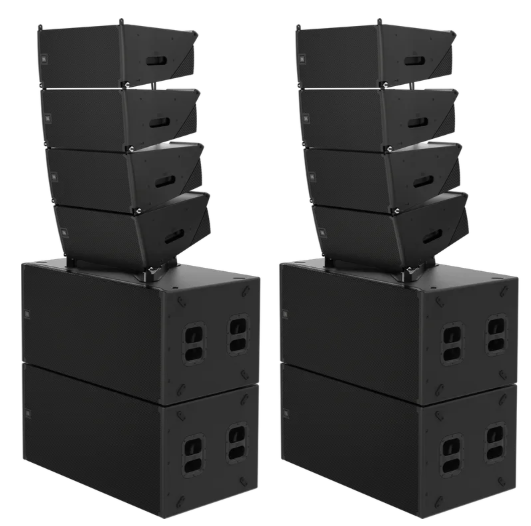
A mix of a curvature array and point-source subwoofers.
Constant Curvature and Hybrid Arrays
Constant curvature and hybrid array systems occupy a middle ground between traditional line arrays and point-source designs.
These systems:
- Use pre-defined curvature rather than adjustable splay angles
- Simplify deployment and tuning
- Reduce rigging and configuration complexity
They often make sense when:
- Room depth is moderate rather than extreme
- Budgets are constrained
- Coverage requirements are predictable
The tradeoff is reduced flexibility compared to fully adjustable line arrays. While performance can be excellent in appropriately sized rooms, these hybrid systems may not offer the same level of fine-tuned vertical control for larger or more complex spaces.
Large Point-Source Systems
Large-format point-source loudspeakers are still used in some worship centers and sanctuaries, particularly where room geometry is favorable. They're a simpler and less intimidating solution if the environment is well-suited to them.
They can work when:
- Seating depth is relatively short
- Ceilings are lower
- The room is acoustically treated
- Coverage areas are simple and symmetrical
However, point-source systems face limitations at scale. As room size increases, maintaining consistent coverage without excessive reflections becomes more difficult, especially in spaces with balconies or wide seating areas. In very large rooms, point-source designs often struggle to deliver uniform intelligibility across all seats.
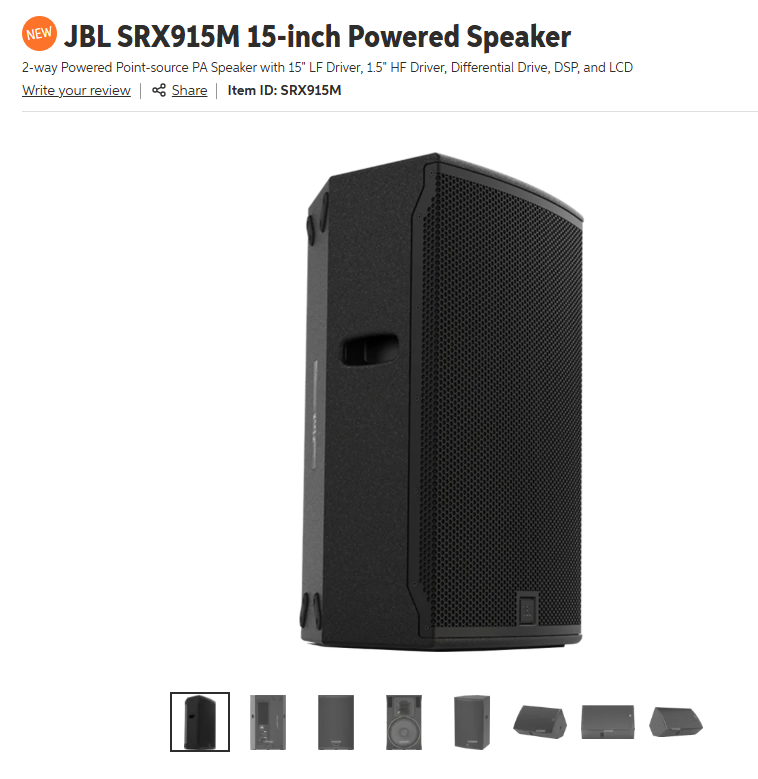
Point-source speakers are a more traditional setup, with several directional cabinets like this one. While this can work in some larger spaces, it's trickier to optimize in a reverberant room, though cheaper than line arrays in most scenarios. That's the trade off.
Choosing the Right Approach
Each system type has a valid place in large worship environments when matched correctly to the room and use case. The most successful designs evaluate:
- Room dimensions and seating layout
- Acoustic conditions
- Primary use (speech vs music)
- Budget and scalability requirements
Rather than asking which system is “best,” churches are better served by identifying which system type is most appropriate for their specific worship space.
Rather than asking which system is “best,” churches are better served by identifying which system type is most appropriate for their specific worship space.
Subwoofers and Low-Frequency Control in Worship Spaces
Low-frequency sound plays an important role in modern worship music, but it's also one of the most common sources of clarity problems in large worship centers. In many cases, issues attributed to “poor sound” are actually the result of uncontrolled low-frequency energy, not a lack of volume or equipment quality.
Designing the low end carefully is essential to maintaining intelligibility and balance.
Low frequencies carry a lot of energy and travel easily through large spaces. When not properly controlled, they can:
- Mask vocal intelligibility
- Reduce articulation in speech and singing
- Create uneven sound levels across seating areas
- Increase listener fatigue
In many cases, issues attributed to “poor sound” are actually the result of uncontrolled low-frequency energy, not a lack of volume or equipment quality.
Unlike higher frequencies, low frequencies are difficult to absorb and control acoustically. As a result, excessive subwoofer output often causes more harm than benefit in reflective worship environments.
Read more: Subwoofers we recommend for church sanctuaries
Typical Subwoofer Counts for Large Sanctuaries
There is no universal subwoofer count that applies to every worship center, but large sanctuaries commonly use fewer subwoofers than expected. For example, our sanctuary that seats roughly 400 uses two, one on the right of the stage and one on the left. Even then, we could probably get away with one sub.
In many cases:
- Speech-focused worship centers use modest low-frequency support
- Music-heavy services justify additional subwoofers for headroom
- Proper placement matters more than raw quantity
Subwoofer requirements should be based on:
- Room size and geometry
- Musical style and instrumentation
- Desired impact level, not maximum output capability
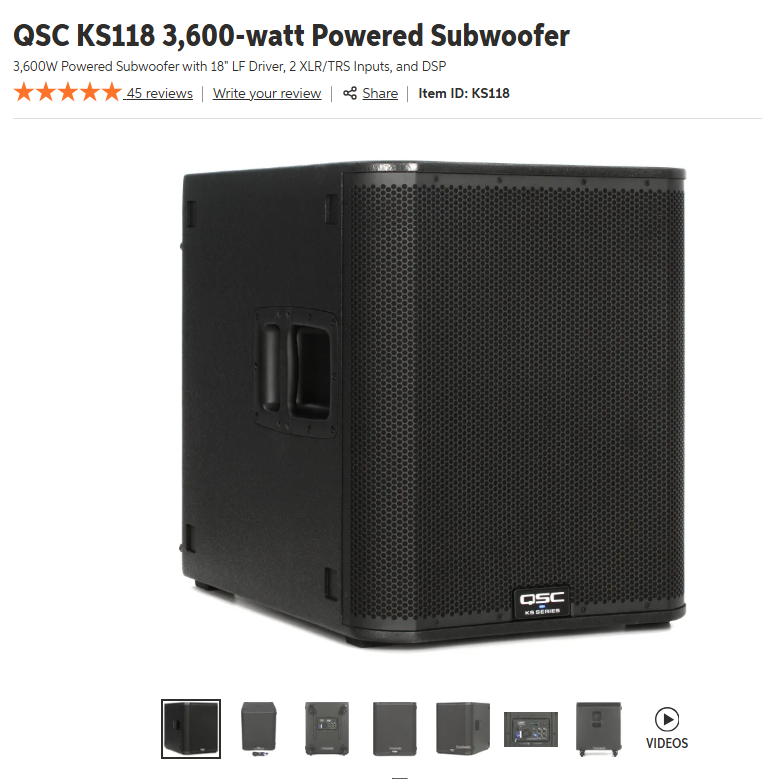
In churches, even large ones, two subwoofers can go a long way. This is a good are to start smaller and expand only if needed.
Ground-Stacked vs Flown Subwoofers
Subwoofers in worship spaces are typically deployed in one of two ways:
- Ground-stacked subwoofers, placed on or near the floor
- Flown subwoofers, suspended with the main loudspeaker system
Ground-stacked subs are more common and generally easier to implement. They benefit from floor coupling, which increases low-frequency efficiency, but they can also introduce uneven coverage if placement is not carefully considered.
Flown subwoofers can improve coverage consistency in some spaces, but they increase rigging complexity, cost, and structural considerations. They are typically reserved for larger or more specialized installations.
Cardioid and Directional Subwoofer Arrays
Directional subwoofer configurations are increasingly used in large worship centers to control low-frequency energy.
These designs:
- Reduce low-frequency buildup on stage
- Minimize rearward sound reflections
- Improve clarity in the congregation area
Cardioid or end-fire sub arrays are especially helpful in wide or reflective rooms where uncontrolled bass energy would otherwise overwhelm the space.
Balancing Impact with Restraint
Effective worship sound systems deliver musical impact without sacrificing clarity.
This balance is achieved by:
- Prioritizing vocal intelligibility
- Controlling low-frequency energy rather than maximizing it
- Using system DSP to shape and align subwoofer output
- Designing for consistent coverage rather than peak output
In worship environments, restraint is often the difference between sound that feels powerful and sound that feels overwhelming.
System Processing, DSP, and Control
In large worship centers, sound quality is shaped as much by how the system is configured and controlled as by the loudspeakers themselves. At this scale, thoughtful system processing is what turns capable equipment into a reliable, repeatable tool that serves the church week after week.
This is where design and discipline matter more than gear choices.
Dedicated System DSP vs Mixer EQ
A critical distinction in professional sound systems is the difference between system-level DSP and mixer EQ.
- System DSP is used to:
- Align loudspeakers to the room
- Manage crossovers and protection
- Control overall system response
- Mixer EQ is used to:
- Shape individual microphones and instruments
- Adjust tonal balance for program material
Relying on the mixing console to correct system problems is a common mistake. Proper system DSP should be configured once and protected, allowing the mixer to focus on content rather than compensating for room or system issues.
Alignment Between Mains and Subwoofers
Time and phase alignment between main loudspeakers and subwoofers is essential for clarity and consistency.
When alignment is correct:
- Low frequencies reinforce rather than smear vocals
- Transitions between frequency ranges feel natural
- Coverage remains consistent across seating areas
Poor alignment can result in:
- Hollow or muddy sound
- Inconsistent bass response
- Reduced intelligibility even at moderate volumes
Proper alignment is achieved through measurement-based tuning, not guesswork or listening tests alone.
Presets for Speech vs Music
Large worship centers often support a wide range of services and events. Well-designed systems account for this through recallable presets.
Common uses include:
- Speech-focused presets with restrained low end
- Music-focused presets with additional headroom
- Event-specific profiles for special services or concerts
Presets allow the system to adapt to different needs without compromising the underlying design or requiring extensive reconfiguration.
Networked Monitoring and Reliability
Modern sound systems increasingly rely on networked control and monitoring to ensure reliability.
Networked systems allow teams to:
- Monitor amplifier and loudspeaker health
- Identify faults or overload conditions early
- Reduce downtime during live services
- Maintain consistent performance across multiple operators
For churches with limited technical staff, these tools provide valuable visibility into system performance and reduce the risk of unexpected failures.
Why Tuning Matters More Than Brand
At the professional level, most reputable manufacturers produce capable loudspeakers. What differentiates outcomes is not the logo on the cabinet, but how the system is designed and tuned.
A well-tuned mid-tier system will often outperform:
- A premium system that is poorly aligned
- A powerful system with uncontrolled low end
- A complex system without proper presets or protection
Investing in professional system tuning and commissioning is often one of the highest-return decisions a church can make.
Rigging, Safety, and Installation Considerations
In large worship centers, sound system installation is not just a technical decision — it is a safety, liability, and long-term stewardship issue. Loudspeakers, rigging hardware, and mounting structures must be treated as part of the building infrastructure, not temporary production gear.
For church leadership and boards, this section is about ensuring that sound system decisions are safe, defensible, and sustainable.
Flown vs Ground-Stacked Arrays
Large worship centers typically deploy loudspeaker systems in one of two ways:
- Flown arrays, suspended from ceiling structure or truss
- Ground-stacked arrays, built from the floor or subwoofer base
Flown arrays are common in permanent church installations because they:
- Provide more consistent coverage
- Reduce visual obstruction
- Keep equipment out of reach of congregants
- Allow more precise aiming and tuning
Ground-stacked systems may be appropriate where:
- Structural rigging points are unavailable
- Portability or temporary use is required
- The room layout limits overhead suspension
However, ground-stacked systems require careful stability planning and typically offer less flexibility in large, deep rooms.
Structural Load Verification
Any flown loudspeaker system introduces significant load to the building structure.
Key considerations include:
- Total weight of loudspeakers and rigging hardware
- Load limits of beams, trusses, or ceiling attachment points
- Required safety factors under local building codes
- Dynamic loads caused by movement or vibration
Structural load verification should be performed by a qualified professional and documented prior to installation. Manufacturer ratings alone are not sufficient without confirming the building’s ability to support the system safely.
Certified Rigging Hardware and Professional Installation
Professional sound systems rely on manufacturer-approved rigging hardware designed specifically for each loudspeaker model.
Best practices include:
- Using only certified fly frames, pins, and suspension hardware
- Following manufacturer limits for array length and angles
- Avoiding improvised or third-party rigging solutions
- Ensuring installation is performed or supervised by trained professionals
Rigging is not an area for experimentation or shortcuts. Proper hardware and trained installers protect both people and property.
Permanent vs Temporary Installation Realities
Permanent worship center installations differ significantly from temporary or touring setups.
Permanent installations must account for:
- Long-term structural loading
- Seismic requirements where applicable
- Access for inspection and maintenance
- Integration with lighting, HVAC, and architectural elements
Temporary or portable deployments still require:
- Rated base plates or stacking frames
- Proper weight distribution and stability
- Physical barriers or protection from public access
- Compliance with local safety regulations
In both cases, safety standards remain the same — permanence does not reduce responsibility.
Inspection, Maintenance, and Long-Term Safety Planning
Once installed, sound systems require ongoing oversight.
Responsible safety planning includes:
- Periodic visual inspections of rigging hardware
- Re-evaluation after system changes or expansions
- Documentation of installation and maintenance history
- Clear procedures for reporting and addressing concerns
Any time additional loudspeaker elements are added or repositioned, the system should be re-assessed for structural and safety compliance.
Why This Matters for Church Leadership
Improper rigging or installation can result in:
- Serious safety risks
- Insurance complications
- Legal exposure
- Costly corrective work
For this reason, rigging and installation costs should be viewed as essential components of the system, not optional upgrades.
Volunteer-Friendly Operation and Training
Most large worship centers rely heavily on volunteer audio teams, making usability and consistency just as important as sound quality. Even the best-designed system will struggle if it depends on a small number of highly specialized operators to function properly.
A volunteer-friendly approach ensures that good sound is repeatable, not operator-dependent.
Simple, Predictable Control Surfaces
Sound systems that are easy to operate reduce stress and errors during services.
Effective designs emphasize:
- Clear, logical signal flow
- Intuitive mixer layouts
- Limited access to system-critical controls
- Consistent gain structure from week to week
When volunteers understand what controls matter — and which ones should not be touched — overall performance improves dramatically.
Locking Down System DSP
System-level DSP should be configured once and protected.
Best practices include:
- Restricting access to system tuning and alignment settings
- Preventing accidental changes to crossovers, delays, and limiters
- Keeping system processing separate from day-to-day mixing tasks
This allows volunteers to focus on mixing content without risking system stability or safety.
Presets and Recallable Scenes
Recallable presets are one of the most powerful tools for volunteer teams.
Common applications include:
- Sermon-only services
- Full band worship
- Special events or guest speakers
Presets reduce setup time, improve consistency, and help less-experienced operators achieve reliable results without extensive troubleshooting.
Reducing “Operator-Dependent” Sound Quality
One of the most common challenges in church sound is inconsistent results from week to week.
A well-designed system minimizes this by:
- Establishing consistent starting points
- Using presets to manage complexity
- Limiting unnecessary adjustments
- Standardizing microphone and stage layouts
The goal is not to remove flexibility, but to ensure that the system sounds good regardless of who is operating it.
Documentation and Ongoing Training
Clear documentation and training are essential for long-term success.
Effective churches invest in:
- Written system guides
- Clear labeling of equipment
- Training for new volunteers
- Periodic refreshers for existing teams
Documentation reduces reliance on institutional memory and helps new team members contribute more confidently and quickly.
Budget Ranges and Cost Drivers for Large Worship Center Systems
For large worship centers, sound system costs are often underestimated because attention is placed primarily on loudspeakers rather than the complete system. In reality, overall performance, reliability, and long-term value are shaped by several interconnected factors beyond the speakers themselves.
Understanding these cost drivers helps churches budget responsibly and avoid decisions that lead to frustration or expensive corrections later.
Broad Budget Tiers for Large Worship Centers
While every room is different, large worship center sound systems generally fall into one of three broad budget tiers:
- Entry-level professional systems
Designed to meet essential coverage and clarity needs with limited scalability. These systems prioritize speech intelligibility and basic musical support while controlling cost. - Mid-tier systems
Offer improved coverage consistency, greater headroom for music, stronger DSP capabilities, and better long-term flexibility. This tier is common for growing churches with mixed programming. - Premium systems
Built for maximum consistency, scalability, and performance. These systems typically support complex seating layouts, higher musical demands, advanced control, and long service life.
These tiers are not about prestige — they reflect differences in coverage control, flexibility, and future-proofing.
What Drives Cost Beyond the Speakers
Loudspeakers are only one part of a properly designed system. Several other components significantly affect total cost and performance.
Rigging and Structural Work
Permanent installations require:
- Certified rigging hardware
- Structural verification
- Professional installation labor
Rigging costs are tied directly to safety and liability and should never be minimized.
System DSP and Control
Professional systems require:
- Dedicated system processing
- Alignment and tuning tools
- Networked monitoring and control
These elements ensure consistency, protect equipment, and reduce operator error.
Installation and Commissioning
Proper installation includes:
- Physical deployment
- Cable infrastructure
- Measurement-based tuning
- System verification
Commissioning is where performance is finalized, and skipping it often leads to disappointing results regardless of equipment quality.
Acoustic Treatment
Acoustic treatment is frequently overlooked, yet it directly affects clarity.
Even partial treatment can:
- Improve speech intelligibility
- Reduce the need for excessive system output
- Allow smaller systems to perform more effectively
In many cases, modest acoustic investment improves results more than additional speakers.
Why Under-Spec’d Systems Cost More Over Time
Attempting to minimize upfront cost often leads to higher long-term expenses.
Common consequences include:
- Adding equipment to compensate for poor coverage
- Replacing systems that cannot scale
- Ongoing dissatisfaction with clarity or consistency
- Increased stress on volunteers and staff
Systems designed with appropriate coverage, processing, and flexibility tend to remain effective longer and require fewer corrective upgrades.
A Practical Budget Perspective
For large worship centers, the most cost-effective approach is rarely the lowest initial price. Instead, value comes from:
- Designing for the room, not just the stage
- Prioritizing clarity and consistency
- Budgeting for installation, tuning, and training
- Planning for future growth
When expectations are set realistically, churches are better positioned to invest wisely and steward resources responsibly.
Questions Church Leadership Should Ask Before Approving a Sound System
Before approving a sound system for a large worship center, church boards and leadership teams benefit from stepping back and confirming that the proposal aligns with long-term ministry needs — not just immediate technical goals.
The following questions help frame sound decisions clearly and responsibly.
Will speech be clear in every seat?
- Has the system been designed to deliver consistent speech intelligibility throughout the room?
- Will clarity extend to back rows, side seating, and balconies?
- Has coverage been modeled or evaluated rather than assumed?
Clear speech is not a luxury — it is foundational to communication.
Is the system scalable as the church grows?
- Can additional seating or services be supported without replacing the entire system?
- Are loudspeaker arrays modular and expandable?
- Has future growth been considered in the initial design?
Scalability protects today’s investment while allowing for tomorrow’s needs.
Who will tune and support the system long-term?
- Will the system be professionally tuned and commissioned?
- Is there a clear plan for ongoing support and maintenance?
- Who is responsible if performance issues arise?
Sound systems perform best when responsibility and support are clearly defined.
How will success be measured?
- What does “good sound” mean for this space?
- Will intelligibility, coverage, and consistency be evaluated?
- Is feedback from the congregation and staff part of the process?
Clear success criteria prevent subjective frustration and set realistic expectations.
Is the system volunteer-friendly?
- Can trained volunteers operate the system confidently?
- Are system-level settings protected from accidental changes?
- Are presets, documentation, and training included?
A system that depends on a few specialists is difficult to sustain over time.
Key Perspective for Boards
The best sound system decisions are those that prioritize clarity, safety, consistency, and stewardship over short-term impressions or specifications.
Final Guidance: Designing for Ministry, Not Just Sound
In large worship centers, sound systems are most successful when they serve a clear purpose: supporting communication without becoming the focus. While technology plays an important role, it is only effective when it reinforces clarity, consistency, and reliability.
Clarity allows the message to be heard and understood without effort. When speech is intelligible in every seat, attention stays where it belongs — on the content being shared, not on the mechanics of delivery.
Consistency builds trust. Systems that perform the same way week after week reduce distraction, lower stress for volunteers and staff, and create a dependable experience for the congregation. Reliable sound allows services to flow naturally, regardless of who is operating the system.
Well-designed systems tend to disappear into the experience. When coverage is even, levels are appropriate, and transitions feel natural, the technology fades into the background. The congregation engages without being reminded of the equipment supporting the moment.
Ultimately, the best worship center sound systems are not defined by their components, but by their outcomes. They support the message, enable participation, and function quietly and reliably in service of the church’s mission.
Designing with this perspective leads to decisions that are not only technically sound, but also responsible, sustainable, and aligned with long-term ministry goals.
Related Church Audio Content
Written by Guitar Chalk on Pro Audio & Comparisons
Written by Bobby Kittleberger on Pro Audio & Roundups
We link to products on Sweetwater that help support our site and keep the lights on. If you click through our orange buttons, we might earn a commission at no extra cost to you. Thank you all for your generous support over the years! ~ Bobby and Danielle
Our disclosure↬


Comment Policy: You're down to leave a comment? That's awesome. Keep in mind that comments are moderated and rel="nofollow" is in use. Please avoid any spammy keywords or a domain as your name, otherwise your comment will be deleted. Let's stay on topic, keep questions relevant and have a meaningful conversation. All the best.