

Mesa Boogie Dual Rectifier / 95.7

- Players chasing modern high-gain tones (metal, hard rock, modern punk)
- Guitarists who want massive low end and aggressive punch
- Bands playing loud stages where headroom and power matter
- Players who like channel switching and tonal flexibility
- Studio users needing a recognizable, record-ready heavy tone
- Guitarists running drop tunings or extended-range guitars
- Players who want an amp that cuts through dense mixes
- Those who appreciate a pro-level, tour-proven amp platform
- Bedroom players or apartment setups (overkill, volume matters)
- Players looking primarily for sparkly cleans or vintage breakup
- Blues, jazz, or classic rock purists
- Anyone wanting simple, one-knob operation
- Players on a tight budget (amp + cab + maintenance adds up)
- Guitarists who dislike tight, modern voicing and compressed gain
- Players who don’t want to deal with tube maintenance
- Those who prefer lightweight or grab-and-go rigs
Mesa Boogie is one of the most sought-after amp manufacturers of our time, trusted by a massive list of professional guitar players, particularly in the hard rock and metal genres. Their artist list page is one of the largest such we've ever seen and includes the likes of Mark Tremonti, Dave Grohl, Adam Jones, Korn, Maroon 5, and tons more. This page highlights three Mesa amp heads we'd recommend specifically for metal and modern rock.
Read the full review: Mesa/Boogie Badlander 25
Full List of Mesa Amp Heads (metal and high gain)
Mesa Boogie Dual Rectifier / 95.7 ⭐
Mesa Boogie Mark Five:25 / 94.8 ⭐

Mesa Boogie Badlander 25 / 92.7 


A shot we took of the Mesa Rectifier Badlander's front panel before its review.
In general, we advise sticking to single or dual rectifier Mesa Boogie amp heads to help keep the price down. We'll also look at one of the Mark Five models, as pictured below.
1. Mesa Boogie Dual Rectifier Head (great for modern high gain)

BEST FOR: Professional recording, gigging, rock, and metal
TONE/STYLE
Modern
EQ LEAN
Heavy
CONTROL SCHEME
Extensive
COST/VALUE
Boutique
- Three independent channels
- Five preamp tubes
- Effects loop
- More footswitch control
- Slave out
- More speaker out selections
- Still no reverb
- Expensive
Three channels and five preamp tubes give you an immediate (and significant) upgrade over the Mini Rectifier. The Dual Rectifier also offers a lot more flexibility on the backend, with more speaker outputs, external switching, more control over your effects loop, and more control at the footswitch level. While both Rectifiers can handle a professional gigging or recording environment, the Dual Rectifier is more firmly seated at the "big kids table."

Some of what's included with the dual rectifier.
2. Mesa Boogie Mark Five Head (versatile with a graphic EQ)

BEST FOR: Flexibility, recording, gigging, and tone sculpting
TONE/STYLE
Modern
EQ LEAN
Heavy
CONTROL SCHEME
Advanced
COST/VALUE
Boutique
- Comes in a combo version
- Graphic EQ is awesome
- Tons of tone control and flexibility
- 8-button footswitch included
- Send/return for each channel
- Reverb on the back panel
- Pricey
There are a few different versions of the Mark Five, broken up by wattage. However, lower-wattage amps usually have similar features and controls, which I'd argue is the biggest strength of the Mark Five series. The Mark V:25 gives you a huge discount with the Mark V series appeal still completely intact.
Read the full review: Mesa/Boogie Mark V:25

Closeup of the Mesa Boogie Mark Five's control panel. Flickr Commons image via Robert Bejil
3. Mesa/Boogie Badlander Series Heads
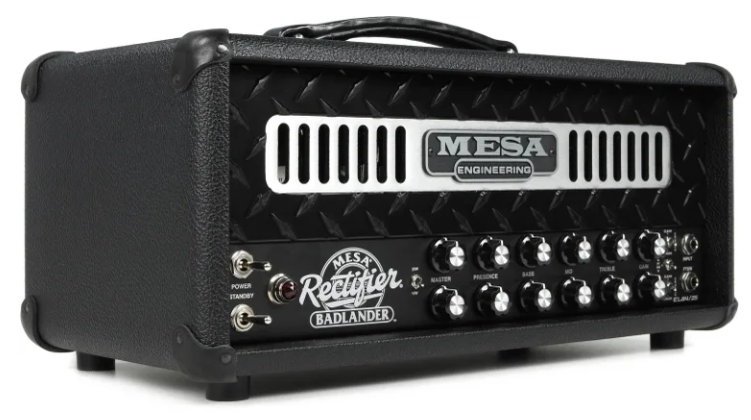
BEST FOR: Recording, live, metal/modern styles, heavy distortion/high gain, multiple styles.
TONE/STYLE
Modern
EQ LEAN
Heavy
CONTROL SCHEME
Advanced
COST/VALUE
Boutique
- CabClone built in (handles speaker load)
- Some nice chime and high end for treble-leaning EQs
- Wattage and cab selection
- Runs the table on gain levels (no distortion pedal needed)
- Comes with a footswitch
- 25 watt version is affordable by Mesa standards
- Direct out and headphone out
- No reverb
I’ve found the Mesa Badlander to line up well against the Mark V, though it skips the familiar graphic EQ section. Both of the 25-watt formats — whether you go with the head or the combo — are reasonably priced, come with CabClone built in, and run on EL84 power tubes. What sets the Badlander apart is its character: it’s noticeably brighter than most Mesa designs and offers plenty of range across its three gain voices — clean, crunch, and crush.
Summarizing Our Three Mesa Amp Choices

A solid combination: PRS & Mesa Engineering - Flickr Commons image via Sergio Leenen
In summary, our top three picks include:
- Dual Rectifier
- Mark Five
- Badlander
While we've given fairly specific recommendations, keep in mind that each amp is part of a series. That means if you find a Mark Five in a different wattage variation than what we've mentioned, it's still going to get you most of the core value we've outlined for the Mark Five 90.
In other words: It might have less control and/or less wattage - but still quite good.
For example, the Recto-Verb listed is a "Dual Rectifier" while mine is only a "Single Rectifier." I didn't let that scare me away from what I already knew was a great amp series. Just keep that in mind as you shop Mesa amps.
Is $2000 much to spend on an amp?
For those wanting a metal, modern-sounding tube amp that's on the cheaper side, I usually recommend Blackstar as a good consolation price. If you can't afford the steeper cost of the Mesa brand, Blackstar is a similar style amp that can get you in the door for less than $1000.
However, to get any kind of Mesa amp - assuming you want to buy new - you'll need to spend around $2000, where $1300 is the low-end with the Mini Rectifier (although I believe this has been discontinued).
Is that too much?
For an amp, I would argue - no - it's not too much.
Because in a lot of ways, an amp has more to say about the overall tone of an electric guitar rig than the electric guitar itself. The tubes, preamp setup, and EQ all play a crucial role, which leads me to suggest that if you're serious about the guitar - specifically the electric guitar - paying between $1500 and $2500 for an amp isn't necessarily overkill.
In my experience, you absolutely get what you pay for and the quality of an amp can make a huge different in your rig.
Where you draw the dollar line is up to you.
Conclusion and Your Questions
Of all the Mesa amps, I'd say the Dual and Triple Rectifiers are my two pure favorites (regardless of cost). The Recto-Verb I use was something my wife found and got a great deal on, saving me from a far more expensive event.
All that to say, just about anything with the Mesa logo on it is going to be a good option for you.
More Guitar Amp Roundups and Content
Written by Bobby Kittleberger on Amps & Roundups
Written by Bobby Kittleberger on Amp Settings
We recommend and partner with Sweetwater for buying music gear, which means if you click through our orange buttons and make a purchase, we might receive a commission at no extra cost to you. ~ Bobby and Danielle
Our disclosure↬


Article written by Bobby the metal head.
What a stupid shill “article”……just another form of advertising.
Advertising? I mean, sort of. Can also be sincere and well thought out.
Come at me.
Crappy article. And the MKV’s have reverb dumb@$$.
You must work for a feckless WOKE company like Gibson.
Yeah missed that. Reverb is on the back panel.
WOKE??? WMD term.
Mesa no longer offers the Roadster, but, in my mind it should be in your list of the top four.
This one, I assume? https://www.mesaboogie.com/amplifiers/electric/rectifier-series/roadster/index.html
That thing is an absolute monster.